

 Back
to listing
Back
to listing
How to Choose the Right Placement Management System for Colleges
How to Choose the Best Placement Management System for Colleges
Introduction
When colleges evaluate placement management software, most ask the wrong first question.
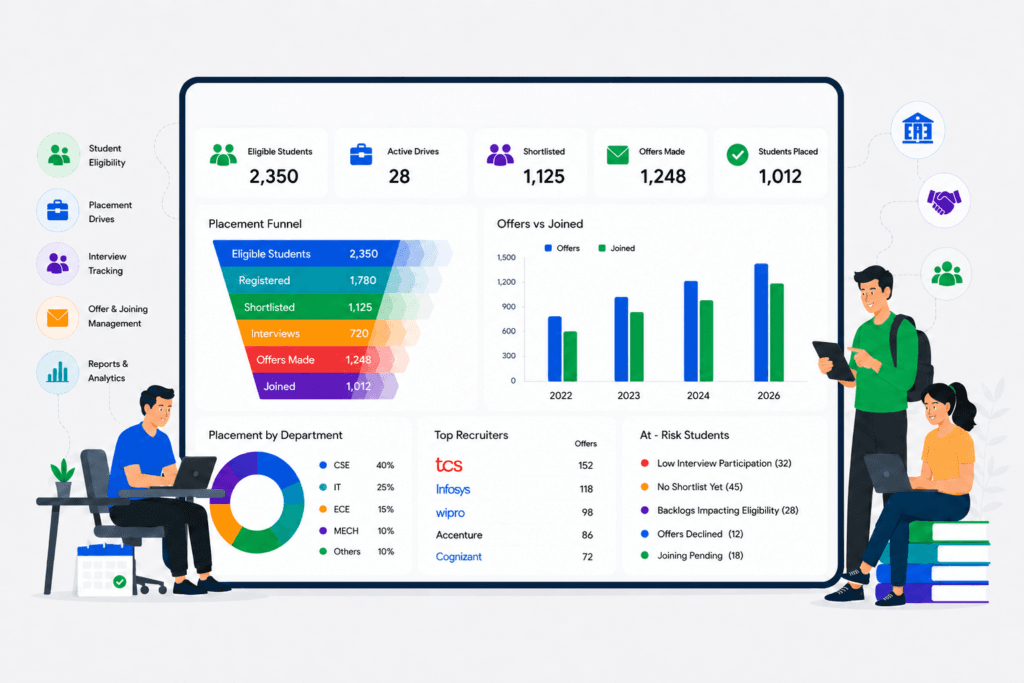
They ask: “Can it manage placement drives?” While important, that question overlooks the broader reality of how modern placement cells operate. A placement drive is only one stage in a much larger process that includes student readiness, eligibility verification, recruiter engagement, interview coordination, offer tracking, joining confirmation, placement analytics, and accreditation reporting.
Today, many institutions are moving from spreadsheets and manual processes to placement management software for colleges, campus placement software, and placement automation software that streamline every stage of the placement lifecycle. The right student placement management system helps placement teams reduce administrative work, improve recruiter relationships, and provide students with a better placement experience.
The right question is not whether a platform can manage placement drives. The right question is whether it can support the placement cell from the beginning of the season to the final placement report.
Indian college placement cells carry a workload that most people outside the department do not fully see. Student readiness, recruiter coordination, eligibility filtering, shortlisting, interview scheduling, offer tracking, joining status, department-wise reporting, and accreditation data all fall on the placement office. In many institutions, these activities are still managed through spreadsheets, email threads, and WhatsApp groups.
A placement management system for colleges is designed to change that. Rather than simply digitizing existing processes, it connects every stage of the placement workflow so data moves seamlessly from one step to the next. This allows placement teams to focus on outcomes rather than administration.
This guide explains what colleges should look for when evaluating a placement management system for colleges, how to compare platforms effectively, what mistakes to avoid, and how the right higher education placement software can improve placement outcomes for students, recruiters, and institutional leadership.
What Is a Placement Management System for Colleges?
A placement management system for colleges is a software platform designed to manage the complete campus placement process from the institution’s perspective rather than the employer’s.
It provides the placement cell with a centralized platform for managing:
- Student profiles and academic eligibility
- Recruiter relationships and company history
- Placement drive scheduling and registrations
- Interview round tracking
- Offer management and joining confirmation
- Placement analytics and reporting
- Accreditation-ready placement data
Modern higher education placement software combines placement tracking, recruiter relationship management, placement analytics, placement reporting, and workflow automation within a single system. Whether referred to as college placement management software, campus placement software, campus recruitment management software, or a training and placement management system, the objective remains the same: helping placement teams manage the complete campus recruitment lifecycle efficiently and accurately.
A well-designed placement management system should be able to answer questions like:
- Which students are eligible for a company’s hiring criteria?
- Who registered for a placement drive?
- Which students were shortlisted?
- Who cleared each interview round?
- Which students received offers?
- Who accepted their offer?
- Which students have confirmed joining?
- Which departments have achieved their placement targets?
- Which recruiters have returned year after year?
When a placement cell can answer these questions instantly from a single source of truth, placement operations become significantly more efficient.
Why Spreadsheets Are Not Enough for College Placement Management
Many placement cells still depend heavily on spreadsheets. While spreadsheets are useful for storing information, they struggle to manage dynamic placement processes involving hundreds or thousands of students, multiple recruiters, and simultaneous placement drives.
Most placement teams encounter familiar challenges:
- Eligibility data becomes outdated quickly
- Recruiter communication is scattered across inboxes
- Student registrations require manual tracking
- Shortlisting takes hours of filtering
- Multiple placement drives create confusion
- Offer tracking becomes difficult
- Placement reports require extensive manual compilation
The issue is not that spreadsheets are ineffective. The problem is that placement management is no longer a simple record-keeping activity.
Today’s placement environment requires continuous coordination between students, recruiters, faculty coordinators, department heads, and institutional leadership. Data changes constantly throughout the placement season. Eligibility criteria differ for every company. Multiple interview rounds occur simultaneously. Reporting requirements extend beyond placements into accreditation and institutional planning.
This is where placement tracking software and placement automation software create measurable value.
Instead of manually updating spreadsheets, colleges can automate eligibility checks, student registrations, interview tracking, recruiter communication, offer management, and placement reporting from a single platform.
As placement volumes grow, manual systems create bottlenecks. A modern placement management system removes those bottlenecks while improving visibility, accuracy, and efficiency across the entire placement lifecycle.
The Full Placement Workflow a System Should Support
One of the most common mistakes colleges make when evaluating placement software is focusing only on placement drives.
Placements do not begin when a recruiter arrives on campus. They begin months earlier through student preparation, recruiter engagement, and eligibility management.
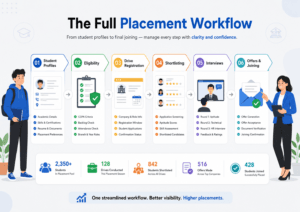
A comprehensive placement management system should support the entire workflow:
Student Profile → Resume Readiness → Skill Development → Eligibility Verification → Recruiter Outreach → Drive Registration → Shortlisting → Interview Rounds → Offer Management → Joining Confirmation → Placement Reporting
If a platform only supports the middle portion of this process, colleges will still need multiple tools and manual workflows to manage everything else.
The value of a connected student placement management system comes from allowing information to flow naturally across every stage without duplication, re-entry, or disconnected records.
When institutions evaluate placement software, they should focus on whether the system supports the complete placement journey rather than isolated activities.
The strongest placement outcomes are achieved when student readiness, recruiter engagement, placement drives, offer tracking, and reporting all operate from a unified platform.
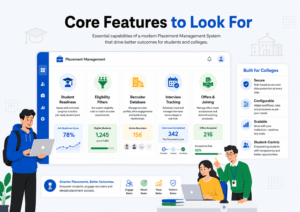
Core Features to Evaluate Before Choosing a Placement Management System
Choosing the best placement management system for colleges requires looking beyond basic placement drive management. The right platform should support student readiness, recruiter engagement, placement tracking, reporting, and long-term placement strategy.
The following features should be considered essential when evaluating college placement management software.
1. Student Profile Management and Placement Readiness
Successful placements begin long before recruiters arrive on campus.
Students need updated profiles, resumes, academic records, certifications, internship details, and placement preferences. Without centralized information, placement officers spend valuable time gathering and validating data before every placement drive.
A modern student placement management system should maintain:
- Student personal information
- Academic records and CGPA
- Department and program details
- Semester-wise performance
- Active backlog status
- Attendance records
- Resume uploads and version history
- Internship experience
- Project portfolios
- Certifications and skill credentials
- Placement preferences and career interests
By maintaining complete student profiles, colleges can improve placement readiness while ensuring recruiters receive accurate candidate information.
2. Automated Eligibility Filtering
Eligibility verification is one of the most time-consuming activities for placement cells.
Every company has unique hiring requirements. Some recruiters prioritize CGPA, while others evaluate departments, skills, certifications, attendance, or backlog status.
Without automation, placement officers manually filter hundreds or thousands of student records for every recruitment drive.
The best placement automation software should allow colleges to:
- Define eligibility criteria for each drive
- Set CGPA thresholds
- Filter by department and program
- Exclude students with active backlogs
- Evaluate attendance requirements
- Consider certifications and skill requirements
- Automatically generate eligible student lists
Automated eligibility filtering reduces administrative effort, minimizes human error, and ensures recruiters receive accurate candidate shortlists.
3. Recruiter Database and Company Relationship Management
Recruiters are not one-time contacts. They are long-term institutional partners.
The best recruiter management software for colleges helps placement teams build a complete history of every employer relationship.
A comprehensive recruiter database should include:
- Company profiles
- Recruiter contact information
- Historical hiring records
- Department-wise hiring data
- Offered job roles
- Salary package history
- Placement drive outcomes
- Recruiter feedback
- Offer-to-joining ratios
- Previous engagement records
The best recruiter management software for colleges goes beyond storing company contact information. It enables placement teams to monitor recruiter engagement history, hiring trends, offer-to-joining ratios, and employer feedback across multiple placement seasons.
This historical information helps colleges strengthen employer relationships, improve recruiter retention, and make data-driven decisions during future placement cycles.
4. Placement Drive Management
Placement drives involve significantly more than scheduling an interview date.
Each drive includes eligibility verification, student registrations, recruiter communication, interview scheduling, document collection, outcome tracking, and reporting.
A placement management system should support:
- Drive creation and configuration
- Job role management
- CTC and compensation details
- Eligibility criteria assignment
- Registration deadlines
- Online and offline venue management
- Communication workflows
- Interview scheduling
- Drive outcome tracking
The platform should also support multiple concurrent placement drives without creating confusion for students or placement officers.
As institutions grow, managing simultaneous recruitment activities becomes impossible through spreadsheets alone. This is where campus recruitment management software provides substantial operational value.
5. Student Registration and Application Management
Students should be able to discover, register for, and track placement opportunities independently.
A good campus placement software platform provides students with visibility into:
- Available placement drives
- Eligibility status
- Registration deadlines
- Application confirmations
- Interview schedules
- Selection status
- Offer updates
From the placement office perspective, the system should provide real-time insights into:
- Registered students
- Eligible students
- Ineligible students
- Withdrawn candidates
- Pending registrations
- Drive participation metrics
Automated registration workflows eliminate dependence on spreadsheets, email chains, and manual forms while improving student engagement.
6. Interview Round Tracking
Modern recruitment processes often involve multiple evaluation stages.
These may include:
- Aptitude assessments
- Coding tests
- Technical interviews
- Group discussions
- HR interviews
- Managerial interviews
Without proper tracking, placement officers struggle to understand where students stand within each recruitment process.
A robust placement tracking software solution should capture:
- Interview round types
- Interview schedules
- Student attendance
- Selection status
- Waitlist status
- Rejection outcomes
- Interview feedback
- Round progression history
Round-level visibility allows colleges to provide targeted support to students while improving placement planning and reporting.
7. Offer Management and Joining Confirmation
Many institutions measure placement success using offer counts.
However, an offer is not the final outcome.
Students may reject offers, receive competing opportunities, delay joining, or choose alternative career paths.
A placement management system should track:
- Offer details
- Job role information
- Compensation packages
- Offer dates
- Acceptance status
- Decline status
- Joining dates
- Final joining confirmation
Tracking the complete offer-to-joining journey provides a more accurate picture of placement performance and recruiter reliability.
The resulting data also helps colleges identify companies with strong joining conversion rates and build stronger recruitment partnerships.
8. Placement Analytics and Reporting
Data-driven decision-making is becoming increasingly important in higher education.
Placement analytics software helps colleges transform operational data into actionable insights.
A modern placement reporting software solution should generate reports such as:
- Eligible vs. registered students
- Placement drive participation rates
- Shortlist-to-offer conversion rates
- Department-wise placement performance
- Program-wise placement statistics
- Company-wise hiring data
- Highest, average, and median CTC
- Offer-to-joining ratios
- Recruiter retention metrics
- Year-over-year placement trends
These reports support multiple stakeholders including:
Placement Teams
Operational visibility into ongoing placement activities.
Institutional Leadership
Strategic insights into placement outcomes and employer engagement.
Accreditation Bodies
Structured placement data for NAAC, NBA, and other compliance requirements.
When placement analytics, placement tracking software, and placement reporting software operate within the same platform, colleges gain complete visibility into their placement ecosystem.
For compliance-focused teams, EDU helps generate accreditation-ready reports without manual compilation.
What Are the Benefits of Placement Management Software for Colleges?
Colleges implementing a modern placement management system often experience benefits across multiple areas.
Reduced Administrative Work
Automated workflows reduce manual data entry, reporting, and coordination tasks.
Faster Placement Operations
Eligibility filtering, registrations, and interview tracking become significantly more efficient.
Better Recruiter Relationships
Structured recruiter data improves engagement and long-term employer retention.
Improved Student Experience
Students gain transparency into placement opportunities, registrations, and outcomes.
More Accurate Placement Data
Placement tracking software provides reliable data for reporting and strategic planning.
Stronger Accreditation Support
Placement reporting software simplifies NAAC and NBA data preparation.
Better Placement Outcomes
When administrative burdens decrease, placement teams can focus on recruiter engagement and student success.
Ultimately, the right placement management software for colleges helps institutions improve efficiency, strengthen employer partnerships, and deliver better placement results.
Placement Management System vs Campus Recruitment Software vs Corporate ATS
When colleges begin evaluating placement software, they often encounter several categories of solutions that appear similar on the surface but serve very different purposes.
Understanding these differences is essential before making a software investment.
What Is a Corporate Applicant Tracking System (ATS)?
A corporate Applicant Tracking System (ATS) is designed for employers.
Its primary purpose is to help organizations manage:
- Job postings
- Candidate applications
- Resume screening
- Interview scheduling
- Offer management
- Recruitment workflows
While ATS platforms work well for corporate hiring teams, they are not designed for college placement workflows.
A typical ATS does not support:
- Student eligibility management
- Department-wise placement tracking
- Placement drive management
- Academic data integration
- Placement cell operations
- Accreditation reporting
- Campus recruitment coordination
As a result, colleges using corporate ATS solutions often end up relying on manual processes to fill critical gaps.
What Is Campus Recruitment Software?
Campus recruitment software is typically built for employers that hire from multiple colleges and universities.
These platforms help companies:
- Schedule campus drives
- Manage recruiter activities
- Track candidates across institutions
- Coordinate interviews
- Manage employer-side hiring pipelines
While campus recruitment software supports college hiring activities, it is still designed from the employer’s perspective.
It focuses on helping recruiters hire efficiently rather than helping institutions manage placements.
For colleges, it lacks many essential capabilities such as:
- Placement tracking software functionality
- Student readiness management
- Eligibility filtering
- Placement reporting software features
- Accreditation-ready reporting
- Department-level placement visibility
What Is a Placement Management System for Colleges?
A placement management system for colleges is built specifically for institutional placement workflows.
Unlike ATS platforms or employer-focused campus recruitment software, it supports every stage of the college placement lifecycle.
This includes:
- Student profile management
- Placement readiness tracking
- Eligibility verification
- Recruiter relationship management
- Placement drive administration
- Interview round tracking
- Offer management
- Joining confirmation
- Placement analytics
- Placement reporting
The best placement management software for colleges acts as a centralized system connecting students, placement teams, recruiters, faculty coordinators, and institutional leadership.
For colleges, this is the category of software that delivers the greatest long-term value.
Quick Comparison
| Feature | Placement Management System | Campus Recruitment Software | Corporate ATS |
|---|---|---|---|
| Built for Colleges | Yes | No | No |
| Student Eligibility Management | Yes | Limited | No |
| Placement Drive Management | Yes | Limited | No |
| Recruiter Relationship Management | Yes | Yes | Limited |
| Interview Tracking | Yes | Yes | Yes |
| Offer Management | Yes | Yes | Yes |
| Joining Confirmation | Yes | Limited | Limited |
| Placement Reporting | Yes | No | No |
| NAAC/NBA Support | Yes | No | No |
| Department-Wise Analytics | Yes | No | No |
| Academic Data Integration | Yes | No | No |
For most institutions, the decision should not be between different recruitment tools. The real question is whether the platform was designed specifically for college placement management.
Questions to Ask Before Choosing Placement Software
The quality of your software evaluation process will directly influence the success of your placement operations.
Before selecting a platform, ask the following questions.
Is the Platform Built Specifically for College Placement Workflows?
Many software vendors claim to support placements.
However, colleges should verify whether the platform includes:
- Academic eligibility filtering
- Placement drive management
- Student placement tracking
- Department-wise reporting
- Recruiter management
- Accreditation reporting
If these capabilities require extensive customization, the platform may not be purpose-built for higher education.
Does the System Integrate With Academic Records?
Placement eligibility depends heavily on academic information.
A strong placement management system should connect with:
- CGPA records
- Semester results
- Attendance data
- Backlog information
- Student enrollment records
Without integration, placement teams spend significant time updating records manually.
Can It Manage Multiple Placement Drives Simultaneously?
Placement seasons rarely involve a single recruiter.
Colleges often manage multiple hiring processes at the same time.
The platform should support:
- Parallel placement drives
- Multiple recruiter workflows
- Independent student shortlists
- Separate interview schedules
- Real-time drive monitoring
This capability is particularly important for large institutions conducting dozens of recruitment drives each semester.
Is the Student Experience User-Friendly?
Student adoption directly impacts the success of any placement management system.
Students should be able to:
- View opportunities
- Check eligibility
- Register for drives
- Upload resumes
- Monitor application status
- Access interview schedules
- Track offers
If students avoid using the system, placement teams will continue handling requests manually.
Does the Platform Support Role-Based Access?
Different stakeholders require different levels of access.
A good placement management software solution should support:
- Placement officers
- Department coordinators
- Students
- Faculty members
- Institutional leadership
Role-based permissions improve security while ensuring users see only relevant information.
Can It Generate Accreditation-Ready Reports?
Accreditation reporting is a major responsibility for colleges.
The best placement reporting software should generate:
- Department-wise placement reports
- Program-wise placement reports
- Placement trends
- Recruiter engagement reports
- Placement outcome reports
This reduces manual reporting effort while improving compliance readiness.
Does It Preserve Recruiter History Across Placement Seasons?
Recruiter relationships are among the most valuable assets a placement office develops.
The platform should retain:
- Recruiter contacts
- Historical hiring data
- Placement outcomes
- Feedback records
- Offer-to-joining statistics
Preserving institutional knowledge improves future recruiter engagement efforts.
Common Mistakes to Avoid When Choosing Placement Software
Many colleges invest in placement software but fail to achieve expected results because they overlook critical evaluation criteria.
Avoid the following mistakes.
Choosing Software That Only Records Final Offers
Offer tracking is important, but it represents only one stage of the placement journey.
A system that focuses solely on offer management still leaves placement teams managing eligibility, registrations, interviews, and reporting manually.
Choose a platform that supports the complete placement lifecycle.
Selecting Generic Recruitment Software
Generic recruitment tools are built for employers, not educational institutions.
Although they may include applicant tracking capabilities, they rarely support:
- Academic eligibility
- Placement workflows
- Accreditation reporting
- Student readiness tracking
Institutions often spend more time adapting generic software than they would implementing a purpose-built placement management system.
Ignoring Student Adoption
Even the most powerful software will fail if students do not use it.
Evaluate the student experience carefully before purchasing any solution.
Look for intuitive workflows, mobile accessibility, and self-service capabilities.
Underestimating Reporting Requirements
Placement reporting extends beyond operational tracking.
Colleges must provide placement data to:
- Management teams
- Governing bodies
- Accreditation agencies
- Regulatory authorities
A system that cannot generate structured reports will eventually create additional administrative work.
Overlooking Recruiter Relationship Management
Placement success depends heavily on long-term employer relationships.
The best recruiter management software for colleges helps institutions:
- Track engagement history
- Improve recruiter retention
- Analyze hiring patterns
- Build stronger employer partnerships
Ignoring this functionality can limit future placement opportunities.
Treating Placement as a Standalone Activity
Placements do not operate independently.
They depend on:
- Academic data
- Student readiness
- Recruiter engagement
- Reporting processes
- Institutional strategy
Disconnected tools create data silos that reduce efficiency and visibility.
A modern placement management system for colleges should serve as a connected platform supporting the entire placement ecosystem rather than a standalone recruitment tool.
How to Evaluate ROI From a Placement Management System
When colleges evaluate a placement management system, they often focus on software costs. However, the real return on investment extends far beyond licensing fees.
A placement management system delivers value by reducing administrative workload, improving recruiter engagement, increasing operational efficiency, and enabling better placement outcomes.
Reduced Administrative Work
A typical placement team spends considerable time on:
- Eligibility verification
- Student communication
- Registration tracking
- Shortlist preparation
- Interview coordination
- Offer management
- Placement reporting
Without placement automation software, these tasks consume hundreds of hours every placement season.
For example, if a college manages 40 placement drives per year and spends 8–12 administrative hours per drive, that represents 320–480 hours of manual effort annually.
A placement management system automates many of these activities, allowing placement teams to focus on strategic initiatives rather than repetitive administrative work.
Improved Placement Outcomes
The impact of placement software is not limited to efficiency gains.
Better placement outcomes occur when:
- Recruiters receive accurate shortlists
- Students register for relevant opportunities
- Interview progress is tracked effectively
- Offer acceptance is monitored
- Recruiter relationships are strengthened
When placement teams spend less time managing spreadsheets and more time engaging recruiters and supporting students, placement performance typically improves.
Better Recruiter Retention
Recruiter engagement often determines placement success.
A strong recruiter management software solution helps colleges:
- Track employer interactions
- Maintain historical hiring records
- Monitor offer-to-joining ratios
- Improve recruiter communication
This information allows placement teams to build stronger relationships and increase recruiter retention over time.
Stronger Reporting and Accreditation Readiness
Many colleges underestimate the time spent preparing placement reports.
Leadership teams, departments, accreditation bodies, and regulatory agencies all require structured placement data.
A placement reporting software solution reduces reporting effort while improving data quality.
The result is greater institutional visibility and less administrative pressure during accreditation cycles.
Long-Term Strategic Value
The strongest ROI comes from enabling capabilities that were previously difficult or impossible.
With the right placement management software for colleges, institutions can:
- Track placement trends
- Improve recruiter engagement
- Increase placement transparency
- Support student employability initiatives
- Generate data-driven insights
- Improve placement planning
The value of these outcomes often exceeds the direct operational savings generated by automation.
How EDU Supports Placement Management
EDU’s Placement Management module is designed specifically for the needs of Indian colleges and universities.
Unlike generic recruitment software or employer-focused applicant tracking systems, EDU supports the complete institutional placement workflow.
Student-Centric Placement Management
EDU enables colleges to maintain complete student placement profiles, including:
- Academic records
- Placement eligibility
- Resume management
- Certifications and skills
- Internship details
- Placement preferences
This helps placement teams identify opportunities quickly and accurately.
Automated Eligibility Management
EDU simplifies one of the most time-consuming placement activities by automating eligibility filtering.
Placement teams can define recruiter-specific requirements based on:
- CGPA
- Department
- Batch
- Attendance
- Backlogs
- Certifications
The system automatically generates eligible student lists, reducing manual effort and minimizing errors.
Recruiter Relationship Management
EDU functions as a recruiter management software platform by maintaining:
- Company profiles
- Contact information
- Historical hiring data
- Recruiter feedback
- Offer history
- Joining outcomes
This helps colleges build stronger employer relationships over time.
Placement Drive Management
EDU allows institutions to manage multiple placement drives simultaneously while maintaining complete visibility across all activities.
Placement teams can manage:
- Registrations
- Shortlists
- Interview rounds
- Student communications
- Recruiter interactions
- Offer tracking
All within a single platform.
Placement Tracking and Reporting
As a comprehensive placement tracking software solution, EDU provides visibility into every stage of the placement journey.
Institutions can track:
- Student participation
- Interview progression
- Offer status
- Joining confirmations
- Department-wise performance
- Recruiter outcomes
This information feeds directly into placement analytics and reporting.
Accreditation-Ready Reporting
EDU simplifies reporting for:
- NAAC
- NBA
- Internal audits
- Governing bodies
- Institutional leadership
Reports can be generated instantly without manual compilation, improving efficiency and accuracy.
A Connected Placement Ecosystem
For placement officers, EDU provides operational control.
For students, it provides transparency.
For recruiters, it improves coordination.
For leadership teams, it delivers actionable insights.
The result is a connected placement ecosystem that improves efficiency, visibility, and placement outcomes.
Placement Management System Buyer Checklist
Use this checklist when evaluating any placement management system for colleges.
Student Management
- Does the system maintain complete student profiles?
- Can students upload and manage resumes?
- Are certifications and skills tracked?
- Can placement preferences be recorded?
Eligibility Management
- Can eligibility criteria be configured for each drive?
- Does the system support CGPA filtering?
- Can it track backlogs and attendance?
- Are eligible student lists generated automatically?
Recruiter Management
- Does the platform maintain recruiter profiles?
- Can historical hiring data be tracked?
- Is recruiter feedback captured?
- Can recruiter engagement history be viewed?
Placement Drive Management
- Can multiple drives run simultaneously?
- Does the system support student registrations?
- Can recruiters receive updated shortlists?
- Are interview schedules managed centrally?
Interview Tracking
- Can interview rounds be tracked individually?
- Are attendance and results recorded?
- Can feedback be captured?
- Is student progression visible?
Offer Management
- Can offers be tracked accurately?
- Is offer acceptance recorded?
- Can joining confirmation be captured?
- Are offer-to-joining ratios available?
Reporting and Analytics
- Does the system generate placement reports automatically?
- Can department-wise reports be created?
- Does it support placement analytics?
- Can NAAC and NBA reports be generated?
User Access and Security
- Does the platform support role-based access?
- Are student records protected?
- Can departments access relevant placement data?
- Is leadership reporting available?
A placement management system that meets most or all of these criteria is far more likely to support long-term placement success.
Conclusion
Choosing the best placement management system for colleges is not simply a software decision. It is a decision that directly influences placement efficiency, recruiter engagement, student experience, and institutional outcomes.
The right placement management software for colleges does more than manage placement drives. It connects student readiness, eligibility management, recruiter relationships, placement tracking, interview coordination, offer management, joining confirmation, and reporting into a single, integrated workflow.
For placement teams, this means less time spent managing information and more time focused on outcomes.
For students, it means greater transparency and improved access to opportunities.
For recruiters, it means smoother engagement and better hiring experiences.
For institutional leadership, it means reliable placement data and stronger reporting capabilities.
As placement expectations continue to evolve, colleges need more than spreadsheets and disconnected tools. They need a comprehensive placement management system that supports the entire placement lifecycle—from the first student profile to the final placement report.
The question is no longer whether colleges need placement software.
The question is whether their current approach can support the complexity, scale, and expectations of modern campus placements.
Explore EDU’s Placement Management module or book a demo to see how your institution can manage placements from student profile to final report.
Frequently Asked Questions
What is a placement management system for colleges?
A placement management system for colleges is software that helps institutions manage the full campus placement process — student profiles, academic eligibility, recruiter relationships, placement drives, interview rounds, offer letters, joining confirmation, and placement reports — in one connected workflow built for the placement cell.
Why do Indian colleges need placement management software?
Manual placement processes — spreadsheets, email threads, WhatsApp coordination — lead to outdated eligibility data, missed recruiter follow-ups, scheduling confusion, incomplete offer tracking, and delayed reports. A placement management system replaces these scattered processes with a connected workflow that the entire placement team and student body can access.
How is a placement management system different from a corporate ATS?
A corporate ATS is built for employers managing their hiring pipeline. It does not support academic eligibility criteria, department-wise tracking, placement drive registration, student readiness, or institutional placement reporting. A placement management system for colleges is built from the institution’s side, for the placement cell’s specific workflows and reporting needs.
What features should a placement management system have?
At minimum: student profiles with eligibility filtering, recruiter database with company history, placement drive creation and management, student registration and shortlisting, round-by-round interview tracking, offer and joining status, and placement analytics including department-wise and accreditation-ready reports.
Can a placement management system help with NAAC and NBA accreditation?
Yes. A system with proper reporting functionality generates placement data in department-wise, programme-wise, and year-wise formats suitable for NAAC and NBA accreditation reviews, without requiring manual compilation at the end of each evaluation cycle.
Is placement management software useful for smaller colleges?
Yes. Smaller institutions benefit from structured student data, recruiter history, accurate eligibility filtering, and clean placement reports regardless of placement volume. The reduction in manual work and the improvement in reporting accuracy apply at any scale.