

 Back
to listing
Back
to listing
Leveraging Technology in Admissions Processes: From Follow-Up Chaos to Connected Admissions
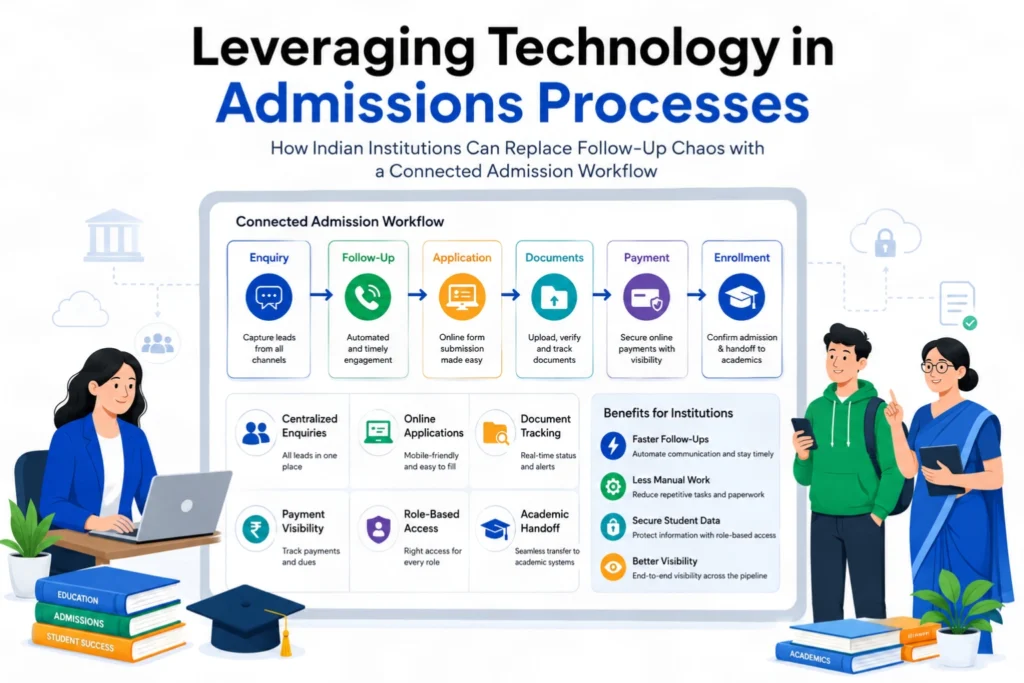
Leveraging Technology in Admissions Processes: How Indian Institutions Can Replace Follow-Up Chaos with a Connected Admission Workflow
Admissions are not lost only because parents stop responding.
They are often lost much earlier.
They are lost when a website enquiry is not assigned quickly.
They are lost when a counsellor forgets a follow-up.
They are lost when a document sits in someone’s WhatsApp chat.
They are lost when accounts confirms payment, but the admission team does not know.
They are lost when a parent has to explain the same query to three different people.
They are lost when leadership sees the problem only after the applicant has moved on.
For many Indian schools and colleges, the admission problem is not demand.
It is leakage.
The institution may be receiving enquiries. The team may be making calls. Parents and students may be showing interest. But if the process between enquiry and confirmed admission is scattered, even good demand can quietly slip away.
This is why leveraging technology in admissions processes has become essential.
Not because every institution needs more software.
Not because every conversation should be automated.
Not because admissions should become cold or robotic.
Technology matters because admissions have become too complex to manage through disconnected registers, spreadsheets, WhatsApp threads, emails, paper forms, and manual department updates.
The modern admission journey needs structure.
A parent or student expects a quick response, a clear next step, a simple application process, document clarity, payment confidence, and regular updates. The admission team needs ownership, reminders, applicant history, and fewer manual reports. Leadership needs visibility without chasing ten different people for updates.
A connected admission workflow brings all of this together.
It helps institutions move from follow-up chaos to process control.
The real problem is not admissions volume. It is process fragmentation.
Every admission season, the pressure feels familiar.
The reception desk is busy. Counsellors are calling. Marketing campaigns are generating enquiries. Walk-ins are being recorded. Application forms are being shared. Documents are being collected. Payment updates are being checked. Leadership is asking for daily numbers.
At first, the process seems manageable.
But as enquiries increase, fragmentation begins to show.
The front desk records a walk-in in one place.
The counsellor updates follow-up notes in another.
The admission office checks applications in a spreadsheet.
Documents are collected over WhatsApp or email.
Accounts tracks payments separately.
Leadership receives a manually prepared report.
Academic teams receive student data only after admission is confirmed.
Each team is working.
But each team is working with a different version of the truth.
This is the core issue.
Admissions are not one department’s job anymore. They involve front office, counsellors, admissions, accounts, document verification, academic teams, transport, hostel, communication, and leadership.
When these teams are not connected, the admission journey becomes a relay race where the baton keeps getting dropped.
An enquiry is captured, but not assigned.
A parent is called, but the note is not updated.
A form is started, but not completed.
A document is submitted, but not verified.
A payment is made, but not reflected.
A student is confirmed, but the academic record is created manually later.
This is process fragmentation.
And it is one of the biggest reasons admission teams feel busy but still lose control.
Why spreadsheets feel safe but create hidden risk
Spreadsheets are familiar.
They feel flexible. They are easy to start. Everyone knows how to add rows, update remarks, filter columns, and share files.
That is why many institutions use them as their admission command centre.
But spreadsheets were not designed to manage a live admission journey.
A spreadsheet can store names and phone numbers.
It cannot reliably manage relationship history.
It cannot automatically capture every website enquiry.
It cannot prevent duplicate records.
It cannot assign a counsellor based on workload.
It cannot remind the team when a follow-up is due.
It cannot show the full call, WhatsApp, email, document, and payment history in one applicant profile.
It cannot tell leadership which applicants are stuck.
It cannot alert accounts when a payment-pending applicant needs support.
It cannot safely control who sees sensitive student data.
It cannot create a clean student record for academics after confirmation.
A spreadsheet is a list.
Admissions are a journey.
That difference is important.
A parent or student does not experience your institution as a spreadsheet. They experience it through response speed, clarity, consistency, and confidence.
When a family submits an enquiry and hears nothing for days, they do not think, “The spreadsheet was not updated.”
They think, “This institution is not responsive.”
When a student submits documents and receives no confirmation, they do not think, “The file is in someone’s inbox.”
They think, “My application is not being handled properly.”
When a parent receives two calls asking for the same information, they do not think, “Two teams are working from different sheets.”
They think, “This process is disorganized.”
That is the hidden cost of manual admissions.
It affects not only internal productivity, but also trust.
The true cost of a scattered admission process
A fragmented admission process does more than create confusion.
It creates institutional risk.
1. Revenue leakage
Every missed follow-up has a financial impact.
A school may lose a parent who was ready for a campus visit but did not receive a callback.
A college may lose a student who started an application but was not guided through document submission.
A coaching institute may lose a serious learner because payment instructions were unclear.
A university may lose a qualified applicant because approval communication was delayed.
In each case, the enquiry was not the problem.
The process after the enquiry was the problem.
Admission leakage becomes revenue leakage.
Even a small number of lost admissions can affect fee planning, seat targets, staffing, resource allocation, and annual budgets.
2. Reputation risk
Admissions are often the first structured interaction a parent or student has with the institution.
If the process feels slow, unclear, or repetitive, it creates doubt.
A parent who has to share the same information multiple times may wonder how the rest of the institution operates.
A student who receives delayed updates may feel the college is not serious.
A family that receives inconsistent fee or document information may lose confidence.
In education, reputation is built not only through infrastructure and results.
It is also built through administrative experience.
A smooth admission process signals professionalism.
A scattered admission process signals risk.
3. Staff burnout
When systems are disconnected, teams compensate with extra effort.
Counsellors search through chats for previous conversations.
Admission staff manually check forms and documents.
Accounts answers repeated payment queries.
Leadership asks for updated reports.
Someone re-enters data into another sheet.
Someone else reconciles mismatched numbers.
The team works harder, but the process still feels unstable.
Technology should not be introduced to pressure teams further.
It should be introduced to remove avoidable friction.
4. Data privacy and security risk
Admissions involve sensitive information.
Student names, parent contact details, academic records, identity documents, category certificates, fee details, and approval notes must be handled carefully.
When this information is shared through email attachments, personal devices, printed files, and multiple spreadsheets, the risk of accidental exposure increases.
A connected digital system can support role-based access, secure storage, and clearer accountability.
This is not just an IT concern.
It is a trust concern.
Parents and students are sharing personal information with the institution. The institution must be able to manage that information responsibly.
5. Audit and compliance difficulty
Schools and colleges need reliable records.
Admission records may be required for internal reviews, statutory reporting, accreditation processes, management reporting, fee reconciliation, and student verification.
When the admission trail is scattered across registers, spreadsheets, emails, and chats, it becomes difficult to produce a clean record.
A connected admission process helps maintain a structured trail from enquiry to confirmed admission.
This makes reporting, verification, and internal governance easier.
What technology should actually do in admissions
Technology in admissions should not be treated as a digital filing exercise.
It should not simply convert paper chaos into digital chaos.
The real purpose is to create a connected admission workflow.
A good admission system should help institutions answer practical questions quickly:
Where did this enquiry come from?
Who owns this case?
Has the parent or student been contacted?
What was discussed in the last conversation?
Has the application been started?
Which section is pending?
Which documents are missing?
Has the document been verified?
Is approval required?
Has the offer been shared?
Is payment pending?
Has payment been confirmed?
Has the student record moved to fees and academics?
When these answers are available in one place, admissions become easier to manage.
The team does not waste time searching for information.
Parents and students do not receive repeated questions.
Leadership does not depend only on manual updates.
Accounts and admissions do not work from different versions of the truth.
The institution gains control over the journey.
That is the real value of technology.
The connected admission workflow Indian institutions need
Before choosing any platform, schools and colleges should define the journey they want to manage.
A practical technology-enabled admission process should include the following stages.
1. Unified enquiry capture
Every admission journey starts with an enquiry.
But today, enquiries do not come from one place.
They may come through:
Website forms
Phone calls
Walk-ins
WhatsApp
Social media
Referrals
Campaigns
Open houses
Education fairs
Webinars
School visits
Counsellor networks
If these enquiries are recorded manually in different places, leakage begins at the first step.
Unified enquiry capture brings all enquiries into one central workflow.
This helps the institution reduce duplicates, identify sources, assign owners, and make sure no enquiry is ignored.
For Indian institutions, this is especially important because parents and students often interact through multiple channels before making a decision.
A parent may first call, then visit, then message on WhatsApp, then fill a form.
A student may attend a webinar, download a brochure, speak with a counsellor, and later start an application.
Technology should connect these touchpoints into one applicant journey.
2. Clear ownership and first response
A new enquiry should not sit untouched because everyone assumes someone else will call.
Every enquiry should have an owner.
The system should show who is responsible, when the enquiry was received, whether it was contacted, and what the next action is.
First response matters because it sets the tone.
A quick, clear response tells the parent or student that the institution is organized and attentive.
This response may be automated in some cases, but the purpose is not to replace counselling. The purpose is to make sure every interested family or student receives timely acknowledgement and a clear next step.
3. Counselling with context
Counselling is where interest becomes clarity.
This is where parents or students ask about curriculum, course fit, eligibility, fees, scholarships, transport, hostel, facilities, documents, deadlines, and next steps.
But counselling becomes weak when the counsellor does not have context.
Has this applicant enquired before?
Which course or grade are they interested in?
What did they ask last time?
Did they attend an event?
Have they received the application link?
Did they submit any documents?
Are they waiting for fee details?
A connected system gives counsellors context before they speak.
That makes conversations more personal, relevant, and useful.
Technology does not remove the human touch.
It helps the human touch become better informed.
4. Paperless application forms
Paper forms and PDF forms create unnecessary friction.
Parents and students may need to download, print, fill, scan, and send documents. The admission team then has to read the form, enter details manually, check missing fields, and follow up for corrections.
A digital application form simplifies this process.
Applicants can fill the form online using a phone or computer. The information flows directly into the admission record. The team can see whether the form is started, incomplete, submitted, or under review.
A good paperless admission process should be:
Mobile-friendly
Easy to understand
Secure
Stage-based
Connected to document upload
Connected to payment or approval steps
Visible to the admission team
The goal is not just convenience.
The goal is accuracy.
When data flows directly from the applicant into the system, manual entry reduces, errors reduce, and the admission record becomes cleaner.
5. Student application tracking
Applications should not be treated as only submitted or not submitted.
There are many stages in between.
An applicant may have filled basic details but not uploaded documents.
A student may have uploaded documents but not completed payment.
A parent may have submitted the form but may be waiting for approval.
A college applicant may need eligibility review before offer release.
Student application tracking helps the team see exactly where each applicant stands.
Useful statuses may include:
Application started
Basic details completed
Documents pending
Documents submitted
Documents under review
Application approved
Offer shared
Payment pending
Admission confirmed
Onboarding pending
This allows the institution to send the right follow-up at the right time.
An incomplete application needs support.
A document-pending case needs a checklist.
A payment-pending case needs fee clarity.
A confirmed case needs onboarding information.
Specific follow-up works better than generic reminders.
6. Document collection and verification
Documents are one of the most common sources of admission delays.
The applicant may not know what is required. The team may not know what has been submitted. The document may be unclear, incomplete, expired, or sent through the wrong channel.
When documents are collected through WhatsApp, email, physical files, and shared folders, tracking becomes difficult.
A digital document workflow gives structure.
Applicants can upload documents in the required format. The team can mark each document as pending, submitted, approved, rejected, or resubmission required.
This makes the process clearer for everyone.
Parents and students know what is pending.
The admission team knows what to follow up on.
The document team knows what to verify.
Leadership can see whether documents are delaying admissions.
A strong document process reduces confusion and helps applications move faster.
7. Follow-up automation that supports, not replaces, people
Follow-up is one of the most important parts of admissions.
But manual follow-up is difficult when the team is handling hundreds or thousands of active enquiries.
This is where automation helps.
Technology can create reminders and messages for common situations:
New enquiry received
Prospectus shared
Counselling scheduled
Application link sent
Application incomplete
Documents pending
Offer shared
Payment pending
Admission confirmed
Onboarding instructions
But automation should be used carefully.
Admissions are emotional decisions. Parents and students still need human guidance, trust-building, and reassurance.
The best use of automation is to handle repetitive updates so counsellors can focus on meaningful conversations.
A parent who needs a document reminder can receive an automated message.
A parent who is confused about fees or curriculum needs a counsellor.
A student who is stuck at eligibility or course selection needs guidance.
Automation should protect the human touch by freeing the team from repetitive manual tasks.
8. Multi-channel communication history
Admissions communication happens everywhere.
Calls.
WhatsApp.
SMS.
Email.
Campus visits.
Events.
Webinars.
Counsellor meetings.
Using multiple channels is not the issue.
The issue is losing the conversation history.
When communication is scattered, teams may ask repeated questions, send inconsistent updates, or miss important commitments.
A connected communication workflow should show what was said, what was promised, when the last interaction happened, and what needs to happen next.
This creates a better experience for applicants.
It also protects the institution.
When every important interaction is recorded, teams have better clarity and fewer misunderstandings.
9. Payment visibility and fee confirmation
Payment is the point where interest becomes commitment.
But payment can also become a major source of confusion.
Parents and students may ask:
How much should be paid now?
Is the seat blocked after payment?
Can payment be made online?
Is there an instalment option?
Has the institution received the payment?
When will the receipt be shared?
What happens after payment?
If accounts and admissions are not connected, the team may not have quick answers.
A counsellor may follow up with a parent who has already paid.
A parent may pay but not receive confirmation.
Leadership may see outdated confirmed admission numbers.
A connected payment workflow gives the right teams visibility.
Admissions can see payment-pending applicants.
Accounts can verify and support payment cases.
Leadership can see confirmations more clearly.
Parents and students receive faster acknowledgement.
This improves trust at a critical stage.
10. Handoff to fees, academics, and administration
Admissions do not end after payment.
Once a student is confirmed, the record must move into the institution’s regular operations.
The fees team needs accurate billing details.
The academic team needs class, course, stream, section, or program information.
Administration may need transport, hostel, ID card, and document details.
Communication teams may need parent and student contact information.
Teachers may need student lists.
Parents and students may need login access.
If confirmed student data is re-entered manually, errors are likely.
A connected admission system should move confirmed student information into fees, academics, and administration without unnecessary duplication.
This helps the institution start the academic year with cleaner records and fewer operational delays.
Why data security must be built into admissions

Admissions data is sensitive.
It includes student identity details, parent contact information, academic records, document uploads, category information, payment details, and internal notes.
In a manual process, this information may be stored in multiple places.
Personal phones.
Email inboxes.
Printed forms.
Spreadsheets.
Shared folders.
Local desktops.
This increases the chance of accidental sharing, outdated files, unauthorized access, or lost records.
A technology-enabled admission process should support role-based access.
This means every team member sees only what they need.
The counsellor can view applicant details and follow-ups.
The document team can view document status.
Accounts can view payment-related information.
Leadership can view overall progress.
Academic teams can view confirmed student records after admission.
Role-based access improves security and accountability.
It also reduces unnecessary exposure of sensitive information.
For schools and colleges, data protection is not only about compliance.
It is about parent and student trust.
How to start without overwhelming your team
The biggest mistake institutions make is trying to digitize everything at once.
That can overwhelm staff and slow adoption.
A better approach is phased.
Start with the biggest leakage point.
Phase 1: Map the current admission process
Before introducing technology, write down every step from enquiry to confirmed admission.
Where does the enquiry come from?
Who contacts the parent or student?
Where is the follow-up recorded?
How is the application shared?
Where are documents collected?
How is payment confirmed?
When does the student record move to academics?
This mapping will reveal the gaps.
Phase 2: Identify the biggest bottleneck
Do not start with the most exciting feature.
Start with the biggest problem.
Are enquiries being missed?
Are follow-ups delayed?
Are applications incomplete?
Are documents slowing down approvals?
Are payments unclear?
Is leadership waiting for manual reports?
Is student data being entered multiple times?
The first phase of technology should solve the most painful issue.
Phase 3: Start with one workflow
Admissions is often the best starting point because it is time-sensitive, parent-facing, and directly linked to enrollment.
Institutions can start with one grade, one course, one campus, or one admission cycle.
A smaller pilot helps the team learn, test, and improve before scaling.
Phase 4: Train people on the process, not just the tool
Training should not only explain buttons and screens.
It should explain the new workflow.
Who owns each enquiry?
When should a follow-up be marked?
How should documents be reviewed?
Who updates payment status?
When does a student become confirmed?
What happens after confirmation?
When staff understand the process, technology adoption becomes easier.
Phase 5: Connect the next departments
Once admissions are structured, connect payments, fees, academics, communication, and administration.
This ensures the confirmed student record does not get stuck after admission.
A phased rollout reduces resistance and makes change easier to manage.
Why education-first technology matters
Not every software platform is built for admissions in educational institutions.
Generic business tools may help track contacts, but schools and colleges need more than contact tracking.
They need workflows built around academic sessions, grade or course structures, document requirements, eligibility, approvals, fee rules, concessions, instalments, communication, parent information, student records, and academic handoffs.
An education-first platform understands that admissions are not only a sales process.
Admissions are connected to academics, finance, administration, compliance, and long-term student lifecycle management.
A strong education-first platform should be:
Modular
Secure
Role-based
Easy to use
Built for education workflows
Scalable across grades, courses, campuses, or programs
Connected with fees, academics, communication, and administration
Capable of supporting digital applications, documents, payments, and reporting
This matters because the admission process should not become another isolated tool.
If the system only captures enquiries but does not connect with applications, documents, payments, and student records, the institution will still face manual handoffs.
The goal is not just to buy software.
The goal is to build a connected admission process.
Where EDU fits
EDU helps Indian schools and colleges bring structure, visibility, and connection into the admission process.
Instead of managing admissions through scattered spreadsheets, calls, forms, WhatsApp chats, emails, and department updates, institutions can use EDU to manage the journey in one connected workflow.
With EDU, institutions can manage:
Enquiry capture
Counsellor follow-ups
Online application forms
Student application tracking
Document status
Payment visibility
Communication workflows
Role-based access
Dashboards
Handoff to fees and academics
This matters because admissions do not work in isolation.
A confirmed student must move into fee records, academic records, communication groups, transport or hostel workflows, attendance, and administration.
When this handoff is manual, errors happen.
When it is connected, the institution saves time and starts the academic year with cleaner data.
EDU helps admission teams move from scattered follow-up to structured progress.
The result is not just faster admissions.
It is better control.
Leadership can see what is happening.
Counsellors can act with context.
Parents and students receive clearer communication.
Accounts can track payment status.
Academic teams receive cleaner student records.
That is what technology should do for admissions.
A practical admission process audit checklist
Before changing the system, institutions should audit their current admission process.
This helps identify where leakage is happening.
Enquiry management
Are all enquiries captured in one place?
Are website, walk-in, phone, WhatsApp, campaign, and referral enquiries connected?
Are duplicate enquiries identified?
Is every enquiry assigned to an owner?
Can leadership see uncontacted enquiries?
Follow-up process
Does every active case have a next action?
Are overdue follow-ups visible?
Can counsellors see applicant history before calling?
Are repeated enquiries prioritized?
Are routine reminders automated?
Application workflow
Can parents or students apply online?
Is the form easy to complete on mobile?
Can the team see incomplete applications?
Are applicants reminded about pending sections?
Does application data flow into the student record?
Document management
Can applicants upload documents securely?
Is document status visible?
Are rejection reasons recorded?
Can applicants see or receive clear pending-document instructions?
Can the team track document delays?
Payment and confirmation
Can admissions and accounts see the same payment status?
Are payment-pending cases visible?
Are fee confirmations timely?
Are instalment or concession approvals recorded?
Does payment completion update the admission status clearly?
Data security
Is applicant data stored securely?
Is access role-based?
Are sensitive documents protected?
Can the institution avoid sharing spreadsheets with personal data?
Can records be retrieved during audits or internal reviews?
Handoff after admission
Does confirmed student data move into fees and academics?
Is duplicate data entry reduced?
Are parent and student details clean?
Are transport, hostel, communication, and administrative requirements captured where needed?
If the answer is “no” to many of these questions, the institution is depending too heavily on manual effort.
That is the right place to begin.
Common mistakes to avoid
Technology can improve admissions only when implemented thoughtfully.
Here are mistakes institutions should avoid.
Mistake 1: Digitizing a broken process
If roles, stages, and rules are unclear offline, technology will only make the confusion digital.
Define the workflow first.
Mistake 2: Creating another isolated system
If the new tool does not connect with applications, documents, payments, fees, or academics, it may become one more place to update data.
The goal is connection.
Mistake 3: Making forms too long
A digital form should not feel like a punishment.
Collect essential information first. Ask for detailed information at the right stage.
Mistake 4: Over-automating communication
Automation helps, but admissions still need human trust.
Use automation for reminders and repetitive updates. Use counsellors for guidance, objections, and decision support.
Mistake 5: Ignoring staff adoption
Software fails when teams do not understand how it helps them.
Show staff how the workflow reduces missed follow-ups, repeated data entry, document confusion, and reporting pressure.
Mistake 6: Looking at reports without changing the process
Dashboards and reports are useful only when they lead to action.
If a bottleneck appears, fix the process behind it.
Conclusion: Better admissions need a better process
Admissions are not just paperwork.
They are not just phone calls.
They are not just forms, documents, and payment reminders.
Admissions are a decision journey.
Parents and students are deciding whether they can trust the institution. Admission teams are trying to guide them. Leadership is trying to understand whether the institution is moving toward its enrollment goals.
When the process is scattered, everyone works harder than they should.
Parents wait longer.
Students get unclear updates.
Counsellors chase information.
Documents go missing.
Accounts works separately.
Leadership sees delayed numbers.
Confirmed student records are recreated manually.
Technology changes this by connecting the journey.
For Indian schools and colleges in 2026, leveraging technology in admissions processes is not about looking modern. It is about reducing leakage, improving trust, protecting student data, and giving teams better control.
The institutions that succeed will not only generate more enquiries.
They will build a process that helps every serious enquiry move forward with clarity, speed, and confidence.
CTA:
Admissions become easier to manage when enquiries, applications, documents, payments, communication, and student records are connected. With EDU, Indian schools and colleges can build a technology-enabled admission process that reduces manual work, improves visibility, and helps teams move applicants from enquiry to confirmed admission with greater confidence.
Book a demo with EDU to see how your institution can leverage technology in admissions processes for 2026.