

 Back
to listing
Back
to listing
Admissions Performance Metrics That Actually Move the Needle: A 2026 Dashboard for Indian Schools and Colleges
Admissions Metrics That Actually Move the Needle: A 2026 Dashboard for Indian Schools and Colleges
It is the middle of admission season. The front desk reports that enquiries are coming in. Counsellors say follow-ups are happening. Parents are asking about fees and students are comparing programs. Documents are being collected, accounts is waiting for payment confirmations, and the admission head has a spreadsheet open.
Leadership has one question: How many seats will we actually fill?
This is where many Indian schools and colleges get stuck — not because the team isn’t working hard, not because leads are poor quality, but because of a fundamental lack of visibility. A parent may have enquired twice, with the second contact treated as a new lead. A student may have half-completed an application, but no one knows which field is pending. A document submitted over WhatsApp is still marked incomplete. A seat has been approved, but payment follow-up is three days late. A counsellor calls regularly, but records no next action.
By the time leadership spots the gap, the admission opportunity may already be gone.
That is why admissions performance metrics matter — not vanity numbers or end-of-month reports, not call counts that look impressive but show no progress. Indian institutions need metrics that answer one practical question: What should we fix today so that more interested families and students reach confirmed admission?
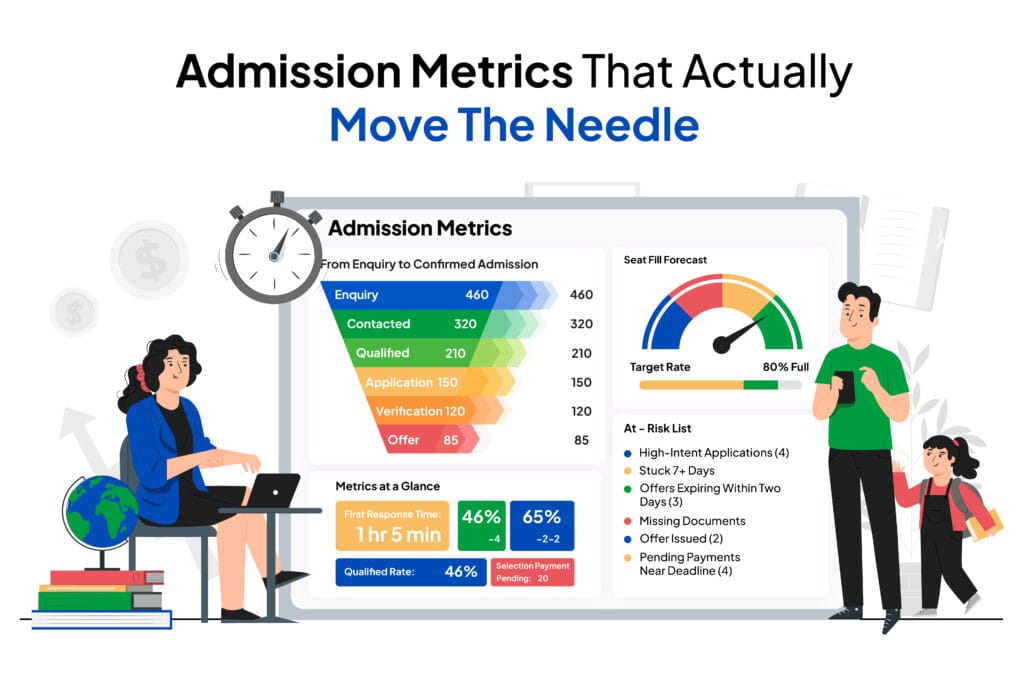
A strong admissions dashboard isn’t a reporting screen. It’s a decision-making tool — one that shows where the journey is moving, where it’s stuck, where applicants are dropping off, and which cases need attention before the window closes. In 2026, the institutions that outperform their peers won’t simply generate more enquiries. They’ll manage every enquiry with better speed, clearer ownership, and end-to-end visibility.
This guide breaks down the admissions metrics that actually make a difference.
The Problem With Enquiry-First Thinking
Every admission season starts with optimism when enquiry numbers look strong. But enquiry volume alone is misleading. A school can receive 1,500 enquiries and still miss its seat target. A college can generate strong campaign leads and still lose applicants at the form, document, or payment stage. A coaching institute can attract hundreds of interested students and fail to convert because follow-ups are delayed or unstructured.
The core mistake is treating enquiries like outcomes. They are only the beginning.
Consider the full journey an enquiry must travel:
- Was the enquiry contacted?
- Was the parent or student qualified?
- Did counselling happen?
- Was the application started — and completed?
- Were documents submitted and verified?
- Was an offer made and accepted?
- Was payment completed?
- Did the student actually join?
Admissions don’t improve when leadership asks only “How many enquiries came in?” They improve when leadership asks, “How many enquiries moved forward this week — and why did the rest stop?” That shift moves the conversation from activity to progress, and it changes everything.
Why Admissions Dashboards Matter More in 2026 ?
The Indian admission landscape has grown meaningfully more complex over the past few years. Digital channels have multiplied the number of touchpoints. Parents and students research more thoroughly, compare more institutions, and take longer to decide. A parent might first see an ad, then call the school, message on WhatsApp, visit the campus, ask about transport, and wait for a family discussion before filling in a form. A student might attend a webinar, download a brochure, consult a counsellor, compare three colleges, and only apply after receiving entrance exam results.
At the same time, competition for serious applicants has sharpened. Institutions that respond slowly, communicate unclearly, or let cases fall through the cracks lose ground to those that don’t. In 2026, with more institutions investing in digital outreach, it’s no longer enough to generate enquiries — the differentiator is what happens after.
This is why a one-line update like “follow-up is happening” or “documents are pending” no longer tells leadership anything useful. A dashboard turns vague updates into clear decisions by showing where applicants are in the journey, how long they’ve been there, who owns the next step, what’s blocking movement, and whether the institution is on track to meet its seat targets. That’s the difference between managing admissions and merely observing them.
The Dashboard Mistakes Most Institutions Make
Many institutions already track admissions in some form. The problem is they often track the wrong things.
Tracking enquiry counts without tracking movement. A high enquiry number can make a dashboard look healthy while hiding serious conversion problems. What actually matters is the percentage of enquiries that move through to application, document verification, payment, and confirmed admission.
Tracking calls instead of outcomes. A counsellor who makes 200 calls in a day shows effort — but did those calls move applicants forward? Call volume only becomes useful when it’s connected to stage movement.
Reviewing reports after the damage is done. If leadership receives a manual report once a week, it’s already looking at history. Admissions need early warning signals. If application completion is dropping today, action needs to happen today.
Letting every department define admission differently. The front office may call a case “active” because a parent enquired. A counsellor might call it “hot” because the parent sounded interested. The admission office might label it “pending” due to incomplete documents. Accounts may not count it until payment clears. Without a shared definition of each stage, every team sees a different reality — and leadership sees none at all.
A good admissions dashboard solves this by creating one consistent, shared view of the journey.
Defining the Admission Journey
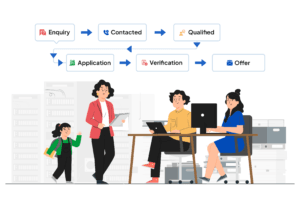
Before any metric can be tracked meaningfully, the stages of the admission journey need to be clearly defined. For most Indian schools and colleges, the journey looks like this:
- Enquiry Received — A parent or student shows interest through a website form, phone call, walk-in, WhatsApp, referral, campaign, event, or social media.
- Enquiry Contacted — The team completes a first meaningful response via call, message, email, or in-person interaction.
- Qualified Enquiry — The counsellor confirms basic fit and intent. For schools, this covers grade, age, board preference, location, transport need, fee expectations, and timeline. For colleges, this includes program interest, eligibility, academic background, entrance score, location preference, and decision timeline.
- Application Started — The applicant begins the form or application process.
- Application Completed — All required application information has been submitted.
- Documents Pending or Verified — Documents are tracked as pending, submitted, rejected, or verified.
- Offer or Seat Approved — The institution approves the applicant based on eligibility, interview, merit, or availability.
- Payment Pending — The applicant has received fee instructions but hasn’t completed payment.
- Confirmed Admission — Payment and all required confirmation steps are complete.
- Joined — The student has joined the academic session.
Once these stages are clearly defined and agreed upon across departments, the dashboard becomes meaningful. Leadership can now see not just how many people entered the process, but how many are actually moving through it.
The Five Metric Categories That Move Admissions Outcomes
A useful dashboard doesn’t need a hundred metrics — too many numbers create confusion rather than clarity. For Indian schools and colleges, admissions performance metrics fall into five practical categories: speed, conversion, drop-off, quality and governance, and forecasting.
Speed Metrics: Are We Responding Fast Enough?
Speed in admissions isn’t about rushing families. It’s about reducing uncertainty. Delay creates doubt — a parent who doesn’t receive a callback may feel ignored; a student who doesn’t get document confirmation starts comparing other options. Speed metrics reveal whether the institution is guiding applicants at the right moment.
Metric 1: First Response Time
What it answers: How quickly is the team responding after an enquiry is received?
First response time shapes the first impression, and during admission season, most parents and students are contacting multiple institutions simultaneously. The one that responds quickly and clearly has a measurable advantage.
Track average first response time broken down by source, counsellor, grade, course, campus, and campaign. Watch for warning signs: website enquiries not contacted the same day, missed calls left unfollowed, campaign leads sitting unassigned, or high-intent enquiries buried among low-priority cases.
The fix is straightforward: set a response target, assign every enquiry to an owner, and run daily checks on uncontacted cases.
Metric 2: Time to First Counselling
What it answers: How quickly does an interested applicant move from enquiry to a meaningful counselling conversation?
Counselling is where interest becomes clarity — where the institution explains curriculum, course fit, eligibility, fees, facilities, and next steps. Tracking two sub-metrics is useful here: enquiry received to counselling scheduled, and counselling scheduled to counselling completed. A high gap between those two often means sessions are being booked but not completed, or that counsellors aren’t recording outcomes.
Every counselling conversation should end with a specific, agreed next action for the applicant — not just a vague “we’ll be in touch.”
Metric 3: Stage Ageing
What it answers: Where exactly is the admission journey getting stuck?
Stage ageing is one of the most powerful metrics available to leadership. It tracks how long applicants remain in each stage. If many are stuck at “Application Started,” the form may be too long or confusing. If cases pile up at “Documents Pending,” instructions are likely unclear. If “Payment Pending” is ageing, the issue is usually in fee communication or payment logistics — not applicant intent.
The key insight here is this: when stage ageing reveals a bottleneck, the solution isn’t to tell the team to “follow up harder.” It’s to fix whatever is causing the friction at that specific stage.
Metric 4: Offer-to-Payment Time
What it answers: How long does it take for an approved applicant to complete payment?
This stage is where many “almost-admissions” become lost admissions. The applicant has shown intent. The institution has approved the case. All that remains is confirmation — and yet, if this stage is slow, institutions frequently lose applicants after doing most of the heavy lifting.
Track offer-to-payment time, payment-pending cases by age, and payment issues by reason. Warning signs include offers sitting open well past expected conversion time, unclear payment instructions, accounts and admissions teams working from different information, and delays in sending receipts or confirmation updates. The fix is precise offer communication: include the fee amount, accepted payment methods, deadline, support contact, and a clear statement of what happens after payment is received.
Conversion Metrics: Where Are We Winning, and Where Are We Leaking?
While speed metrics track how fast the journey moves, conversion metrics track how many applicants move forward. Together, they help leadership identify whether the real problem lies in enquiry quality, counselling, form friction, document delays, payment delays, or post-confirmation onboarding.
Metric 5: Enquiry to Contacted Rate
Formula: Contacted enquiries ÷ total enquiries
If this number is low, admissions are leaking before the first conversation has even happened. Common causes include unassigned enquiries, incorrect phone numbers, missed calls that aren’t logged, walk-ins entered late, and counsellors who are genuinely stretched thin. The solution is to centralise enquiry capture and review uncontacted cases every single day.
Metric 6: Contacted to Qualified Rate
What it answers: Are we attracting and identifying the right applicants?
Not every enquiry is equally worth pursuing. Qualification helps the team focus on relevant and serious cases. For schools, qualification typically covers grade, age, board preference, location, transport need, sibling details, fee fit, and admission timeline. For colleges, it covers course interest, eligibility, academic background, entrance score, location preference, budget, and decision timeline.
If this rate is consistently low, it’s worth reviewing both the source quality and the counselling script. A pattern of irrelevant enquiries often signals that marketing communication is attracting the wrong audience.
Metric 7: Qualified to Application Started Rate
What it answers: Are genuinely interested applicants taking the next step?
This is where intent should become action. If qualified applicants aren’t starting applications, the next step probably isn’t clear or convenient enough. The application link isn’t being shared promptly, the process looks daunting, documents aren’t explained, fee details are vague, or counselling sessions are ending without a firm deadline or follow-up time.
The fix: at the end of every counselling conversation, share the application link, document checklist, fee overview, and a specific follow-up time.
Metric 8: Application Completion Rate
Formula: Completed applications ÷ started applications
An applicant who starts the form has already demonstrated serious intent. A low completion rate means the process itself is creating friction — the form is too long, too many fields are mandatory upfront, document upload is confusing, the experience isn’t mobile-friendly, or applicants simply don’t know what’s still pending.
Targeted reminders make a significant difference here. A message that says “Please complete your application” is weak. A message that says “Your application is 80% complete — the only pending step is uploading your previous academic record” is specific, actionable, and far more likely to convert.
Metric 9: Offer Acceptance Rate
What it answers: Are approved applicants choosing the institution?
A low offer acceptance rate usually means the institution is losing serious applicants at the final decision stage — often for reasons that are entirely preventable. Fee clarity is weak, offer validity isn’t communicated, follow-up after the offer is delayed, or the institution’s value hasn’t been reinforced after the approval.
Strong offer communication should mention seat validity, the exact next step, payment details, deadline, and a direct support contact. High-intent applicants warrant a personal follow-up call, not just an automated message.
Metric 10: Confirmed to Joined Rate
What it answers: How many confirmed students actually show up?
Some institutions stop tracking after payment is received. But the final joining rate matters for class planning, section allocation, hostel and transport logistics, orientation, books, timetables, and academic handoff. Improving this rate comes down to post-confirmation communication: joining instructions, orientation details, parent and student login information, academic calendar, transport details, and key contacts — all delivered clearly and on time.
Drop-Off Metrics: Why Are Applicants Leaving?
Conversion metrics show where applicants are dropping off. Drop-off metrics show why. Without reason tracking, the same problems recur every admission season.
Metric 11: Top Drop-Off Reasons
Useful categories to track include: chose another institution, fees not aligned, delayed response from our side, documents not completed, eligibility mismatch, location or transport issue, parent or student undecided, no response, payment not completed, program or subject not available, timing issue, and duplicate enquiry.
The purpose isn’t just to count these — it’s to act on them. If “documents not completed” is consistently the top reason, document instructions need to be simplified. If “delayed response” appears frequently, it points to an ownership and speed problem. The goal is to review the top three reasons every week and assign one person to fix the biggest one.
Metric 12: No Next Action Count
What it answers: How many active cases have no planned next step?
This is one of the most dangerous leaks in any admissions pipeline. A case can look active in a system while quietly stalling if it has no next action, no due date, and no owner. The fix is a simple rule applied consistently: every active case must have a next action and a due date attached to it.
Metric 13: No-Show Rate
What it answers: Are scheduled interactions — counselling sessions, campus visits, interviews, document appointments actually happening?
A high no-show rate typically means reminders are insufficient, scheduling is inconvenient, or the applicant doesn’t understand the value of attending. Sending confirmation messages, reminders before the appointment, and a brief explanation of what the session will cover goes a long way. Easy rescheduling options also help.
Metric 14: Overdue Follow-Ups
What it answers: How many follow-ups are past their due date?
Overdue follow-ups reveal both missed opportunities and team capacity issues. If a counsellor has a large backlog of overdue tasks, it may be a workload problem rather than a performance one. The response should be to redistribute workload, prioritise overdue high-intent cases, and use automated reminders for routine updates so counsellors can focus their time on meaningful conversations.
Quality and Governance Metrics: Can Leadership Trust the Data?
Poor data produces poor decisions. If records are duplicated, fields are missing, or fee exceptions aren’t tracked properly, leadership can’t rely on anything the dashboard shows.
Metric 15: Duplicate Enquiry Rate
Parents and students frequently enquire through multiple channels. Without proper matching, the same applicant can appear as two or three separate leads — inflating enquiry numbers and confusing counsellors. Records should be matched using phone number, email, student name, parent name, grade or course, and campus interest. Importantly, a repeat enquiry shouldn’t be treated as clutter. It’s a signal of renewed interest and should be prioritised accordingly.
Metric 16: Incomplete Data Rate
What it answers: Can departments rely on applicant records?
For schools, commonly missing fields include student name, grade, date of birth, parent contact, previous school, board, address, transport need, and sibling details. For colleges, gaps typically appear around program interest, eligibility, marks, entrance details, category, documents, and payment status.
The fix isn’t to ask for everything at the enquiry stage. It’s to define minimum required fields for each stage and make sure critical information is complete before approval and confirmation happen.
Metric 17: Document Rejection Rate
A high document rejection rate almost always means instructions are unclear rather than that applicants are careless. Rejections happen because the wrong file was uploaded, image quality is poor, pages are missing, certificates are expired, the format is wrong, or details don’t match. Tracking rejection reasons makes it possible to improve the checklist, specify accepted formats, and give applicants precise instructions on what needs to be corrected.
Metric 18: Fee Exception and Instalment Approval Trail
In Indian institutions, families regularly request concessions, instalments, scholarships, sibling benefits, or special approvals. These requests may be entirely valid — but without a clear approval trail, institutions risk inconsistent commitments, internal confusion, and revenue leakage. Every fee exception should be tracked with concession amount, instalment details, approval owner, reason category, approval date, and final payment status, with defined rules about who can approve what.
Forecasting Metrics: Can We Predict Seat Filling?
This is what leadership ultimately needs to know — not just how many enquiries came in, but whether the institution is genuinely on track to fill its seats with enough time to course-correct if it isn’t.
Metric 19: Confirmed Admissions vs Seat Target
Track this at the level of grade, course, program, campus, stream, and category — not just as a single overall number. A healthy total can hide real risk if one grade, branch, or program is significantly behind. When a gap is identified, the next step is to diagnose its cause: is it low enquiries, low application completion, document delays, approval delays, or payment delays? Each cause has a different solution.
Metric 20: Seat Fill Pace
What it answers: Are admissions happening at the rate needed to meet the target?
If a school needs 150 confirmed admissions by June and only 45 are confirmed by mid-May, leadership needs to know whether the current weekly pace is sufficient to close the gap. Seat fill pace provides that early warning. Critically, if pace is weak, the first response shouldn’t be to increase campaign spend — it should be to check whether existing enquiries are actually moving through the pipeline properly.
Metric 21: Weighted Admission Forecast
What it answers: How many admissions are realistically expected from the current pipeline?
Not all applicants are equally likely to convert. A qualified enquiry and a payment-pending applicant represent very different levels of probability. A simple weighted forecast might assign probabilities like these:
| Stage | Estimated Probability |
| Qualified enquiry | 20% |
| Application started | 40% |
| Application completed | 60% |
| Offer shared | 75% |
| Payment pending | 90% |
These percentages should be calibrated using the institution’s own historical data. The result gives leadership a far more realistic view of expected admissions than raw enquiry count alone — and helps clarify whether the priority is improving conversion, adding counselling capacity, or generating new qualified demand.
Metric 22: At-Risk Admissions List
This final metric is less a number and more an action list. It should surface: high-intent applicants with overdue follow-ups, applications stuck for too long at any stage, documents pending near a deadline, offers not accepted within expected time, payments pending after reminders, cases with no next action recorded, and repeat enquiries that haven’t been prioritised. Reviewing this list weekly, assigning owners, and escalating high-value cases is one of the most direct ways to recover admissions that would otherwise quietly slip away.
The Minimum Dashboard: 8 Metrics to Start With
Not every institution needs to track all 22 metrics from day one. If you’re starting lean, these eight provide enough visibility to meaningfully improve admissions outcomes:
- Total enquiries by source — shows where interest is coming from
- First response time — shows whether the team is responding quickly enough
- Enquiry to application rate — shows whether interest is becoming action
- Application completion rate — shows whether the form journey is smooth
- Document pending count and ageing — shows whether paperwork is blocking progress
- Offer-to-payment time — shows whether serious applicants are converting
- Top drop-off reasons — shows why parents or students are leaving
- Confirmed admissions vs seat target — shows whether the institution is on track
This is enough to give leadership real visibility without overwhelming the admission team.
What Each Team Should See
A useful dashboard doesn’t show the same view to everyone. Different teams need different information to act effectively.
Leadership needs to see target seats, confirmed admissions, expected admissions, gap to target, seat fill pace, major bottlenecks, top drop-off reasons, and the at-risk admissions list.
The Admission Head needs to see enquiries by source, counsellor workload, overdue follow-ups, stage-wise ageing, application status, document status, payment-pending cases, and conversion by stage.
Counsellors need to see today’s follow-up list, high-intent applicants, cases with no next action, incomplete applications, pending questions, scheduled meetings, and overdue tasks.
The Document Team needs to see documents pending, submitted, rejected, and resubmitted — along with rejection reasons and verification ageing.
Accounts needs to see payment-pending applicants, completed payments, failed payments, instalment requests, concession approvals, and receipt status.
This role-based visibility reduces confusion and helps every team act without waiting for someone else to filter and share data.
Running a Weekly Admissions Review
A dashboard only creates value when it leads to decisions. A focused weekly review of 30 to 45 minutes is enough — provided it follows a clear structure.
Pipeline health: How many enquiries came in this week? Which sources changed? Are enquiries being contacted on time? Which grades, courses, or campuses are underperforming? Are all enquiries assigned?
Bottlenecks: Which stage has the highest ageing? Where is conversion lowest? Are applications stalling? Are documents or payments delayed? Are approvals taking too long?
Risk control: Which offers are close to expiry? Which payment-pending cases need urgent attention? Which high-intent applicants have no next action? Which counsellors are overloaded? Which cases need senior intervention?
Decisions: End every review with specific decisions, not general pressure. There’s a meaningful difference between a strong decision and a weak one:
- Weak: “Team, please follow up more.”
- Strong: “We’ll remove non-essential fields from the first form this week.”
- Strong: “Document checklist reminders will go out every alternate day.”
- Strong: “Payment-pending cases will be assigned to accounts within two hours of the offer being sent.”
The goal of every review is to fix the system, not to pressure the team.
Implementing Metrics Without Burdening Staff
The most common concern from admission teams is understandable: will this create more work? It shouldn’t — and it won’t, if implementation is approached correctly.
The best dashboards are built from work the team is already doing. Counsellors shouldn’t be generating manual reports; the system should capture enquiry source, owner, status, communication, documents, payment status, and next action as part of the natural daily workflow.
Step 1 — Define stages clearly. Every team member should know exactly what each stage means, and a case should only advance when real progress has happened.
Step 2 — Assign ownership. Every active case needs an owner. Every pending task needs a due date.
Step 3 — Standardise reason codes. Drop-offs, document rejections, no-shows, and fee exceptions should use a fixed set of options. Free-text notes are useful for context, but standardised reasons are what make reporting actionable.
Step 4 — Keep dashboards role-based. Leadership doesn’t need every counselling note. Counsellors don’t need high-level forecasting screens. Accounts doesn’t need every enquiry detail. Giving each team only the view they need to act reduces noise and increases adoption.
Step 5 — Review daily, improve weekly, reflect monthly. Daily dashboards support operations. Weekly dashboards support leadership decisions. Monthly reviews should be used to improve the process itself.
Where EDU Fits?
Admissions metrics only work when the admission journey is genuinely connected. If enquiry capture lives in one place, follow-up notes are on personal phones, documents are in email, payment status sits with accounts, and student records are entered manually days later, leadership will always be looking at a delayed and incomplete picture.
EDU helps Indian schools and colleges bring the entire admission journey into a single, connected workflow — covering enquiries, counsellor follow-ups, online application forms, document tracking, payment visibility, applicant communication, dashboards, and handoff to fees and academics.
This matters because admissions don’t exist in isolation. A confirmed student must become part of the institution’s academic, fee, communication, and administrative records. A connected workflow gives leadership real-time stage visibility, helps identify bottlenecks before they become losses, reduces manual handoffs between teams, and starts the academic year with cleaner, more complete student data.
The value isn’t just better reporting. It’s real operational control: leadership knows what’s happening, counsellors know what to do next, parents and students receive clearer communication, accounts sees accurate payment status, and academic teams receive reliable records.
Conclusion
Most institutions don’t lose admissions because their teams aren’t working hard enough. They lose admissions because the process isn’t visible enough. A parent asked for a callback, but no one owned the next step. A student’s application sat 80% complete, unnoticed. A document was rejected, but the family didn’t know why. A seat was approved, but payment instructions never arrived. A high-intent applicant waited too long, and moved on.
In 2026, Indian schools and colleges need more than enquiry numbers. They need admissions performance metrics that reveal speed, conversion, drop-off causes, data quality, and seat forecasting — together, in one place, in time to act.
The institutions that perform better won’t simply generate more leads. They’ll manage every enquiry with more clarity, ownership, and timely follow-through — and the foundation for all of that is measuring what actually moves admissions forward.
Admissions improve when leadership can see the journey clearly. With EDU, schools and colleges can manage enquiries, applications, documents, payments, communication, and dashboards in one connected workflow.
Book a demo with EDU to see how your institution can improve admissions visibility and seat forecasting for 2026.