


 Back
to listing
Back
to listing
Exploring NEP 2020: India’s New Education Policy and Its Impact
Understanding NEP 2020: A Comprehensive Guide to the National Education Policy
The National Education Policy 2020 or NEP 2020 represents a transformative vision for India’s education system. Announced in 2020, the New Education Policy aims to create a comprehensive framework that nurtures innovation, inclusivity, and quality learning across all levels — from early childhood to higher education. The NEP 2020 Structure (5+3+3+4) replaces the outdated 1986 model and aligns India’s learning framework with the demands of the 21st century, focusing on flexibility, multidisciplinary learning, and holistic development.
For India — a nation with one of the world’s largest youth populations — education is not just a right but a catalyst for social and economic progress. The NEP 2020 (National Education Policy 2020) seeks to transform this potential into global competence, preparing students for the modern world while preserving India’s cultural and linguistic diversity. It introduces key features of NEP 2020, including new teaching methods, updated curricula, and reimagined academic structures that make education more learner-centric, skill-based, and accessible to all.
As implementation begins, the impact of NEP 2020 on education is becoming increasingly visible — from modern classroom reforms to digital learning integration. Together, these changes mark the beginning of a new era for Indian education built on inclusion, innovation, and excellence.
Historical Context & Evolution
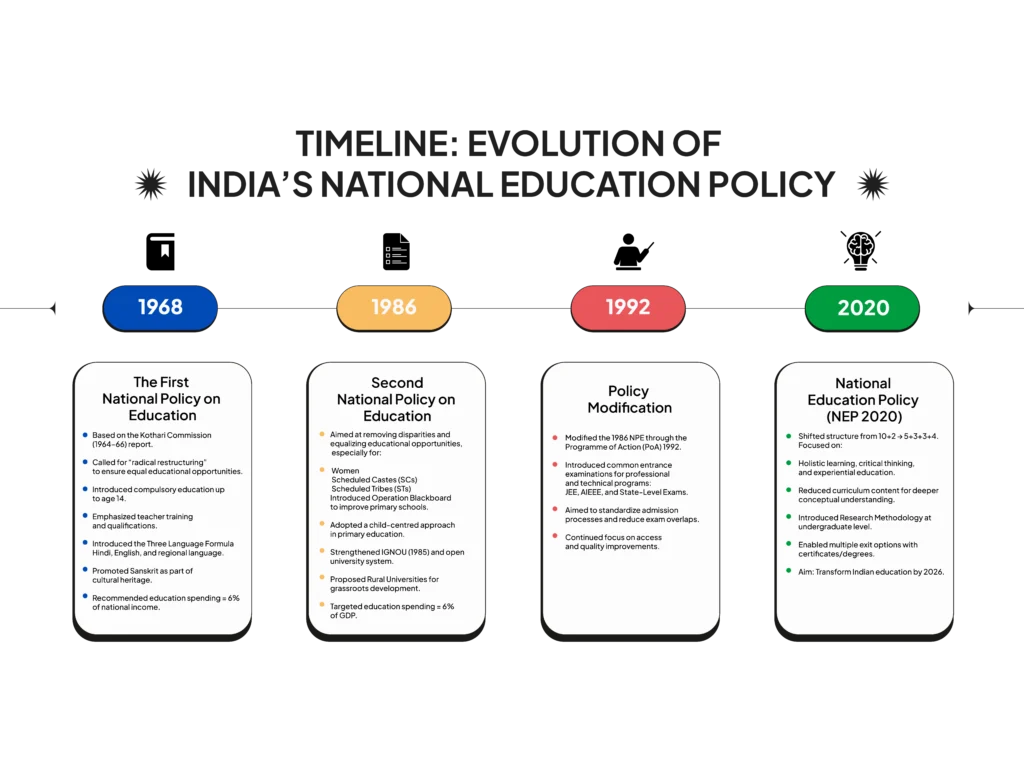
Before NEP 2020, India had two major education policies — the National Policy on Education (1968) and the National Policy on Education (1986). These earlier policies emphasized equality, literacy, and access but were limited by rigid structures and a lack of focus on innovation and employability. Over time, with globalization, technological advancements, and evolving societal needs, the old system became misaligned with the modern economy.
The NEP 2020 (National Education Policy) emerged after extensive consultations involving educators, policymakers, and the public. Spearheaded by the Ministry of Education, it drew insights from over 2 lakh village-level discussions and 15 lakh stakeholder suggestions. The resulting framework is forward-looking — promoting a flexible, multidisciplinary, and technology-driven education ecosystem designed to meet both national aspirations and global standards.
Key Features of NEP 2020
Below are the Key Features of NEP 2020 that shape school and higher education.
School Education Reforms
One of the most transformative aspects of NEP 2020 is its restructured school education framework.This section explains the NEP 2020 Structure (5+3+3+4) and how it replaces the older 10+2 model
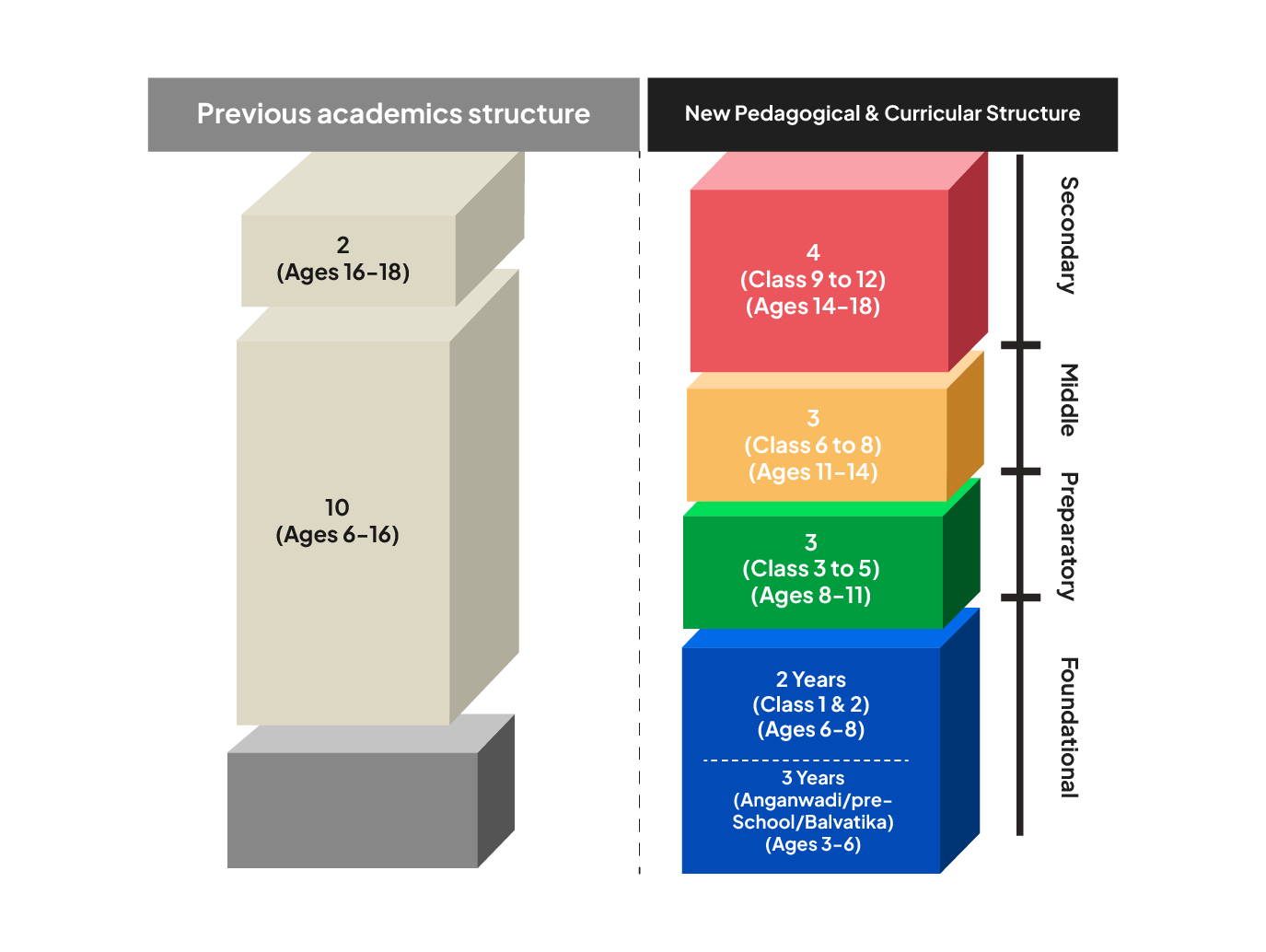
Foundational Stage (5 years): Incorporates pre-primary and Grades 1–2, emphasizing play-based and activity-driven learning.
Preparatory Stage (3 years): Grades 3–5 focus on foundational literacy, numeracy, and experiential learning.
Middle Stage (3 years): Grades 6–8 introduce subject-based learning and critical thinking.
Secondary Stage (4 years): Grades 9–12 offer greater flexibility, multidisciplinary studies, and career exploration.
Early Childhood Care and Education (ECCE) receives significant attention, recognizing the first eight years as crucial for cognitive growth. The policy promotes universal access, inclusive education, and flexible assessments that focus on conceptual understanding rather than rote memorization.
In addition, mother tongue or regional language is encouraged as the medium of instruction until Grade 5 to strengthen comprehension and cultural identity. Digital literacy, coding, and vocational skills are integrated early, ensuring students are future-ready in a world increasingly influenced by AI in Education and digital transformation.
Higher Education Initiatives
In higher education, NEP 2020 envisions a multidisciplinary, holistic system. The rigid silos between arts, science, and commerce are dismantled, promoting flexibility and creativity. Key highlights include:
Four-Year Undergraduate Program (FYUP): Students can exit at different stages with certificates, diplomas, or degrees, allowing greater mobility.
Academic Bank of Credits (ABC): Enables students to digitally store academic credits and transfer them across institutions.
Single Higher Education Regulator: The Higher Education Commission of India (HECI) will oversee standards, funding, and accreditation.
Focus on Research and Innovation: The National Research Foundation (NRF) will strengthen research across disciplines and institutions.
Internationalization of Education: Encourages top global universities to establish campuses in India and promotes student exchange programs.
Teacher Education and Professional Development: Introduces rigorous training, continuous evaluation, and a four-year integrated B.Ed. program.
By fostering creativity, employability, and global competence, NEP 2020 (National Education Policy) aims to position India as a knowledge superpower in the coming decades.
NEP 2020 Implementation
This NEP 2020 Implementation overview outlines stakeholder roles, funding, and timelines.
Roles of Stakeholders
Successful implementation of NEP 2020 requires coordination among multiple stakeholders — central and state governments, educational institutions, teachers, parents, and students. The Ministry of Education serves as the policy driver, while local bodies ensure contextual adaptation. Teachers, as the central agents of change, receive continuous training through initiatives like National Mission for Mentoring (NMM).
Funding & Resources
NEP 2020 recommends increasing public investment in education to 6% of GDP, ensuring equitable distribution of resources. The policy emphasizes the use of technology for cost-effective delivery through platforms like DIKSHA and SWAYAM. Partnerships with private and non-profit organizations are encouraged to expand reach, infrastructure, and innovation.
The Role of Technology in NEP 2020 Implementation
The National Education Policy 2020 (NEP 2020) identifies technology as a powerful catalyst for transforming education across India. From digital classrooms to AI-driven learning tools, technology bridges accessibility gaps and ensures that every learner can experience equitable, high-quality education regardless of geography or background.
Modern digital management systems simplify administration, track progress, and strengthen transparency. These tools help schools and universities manage operations efficiently so that educators can devote more time to teaching and student engagement. Meanwhile, AI-enabled learning platforms personalize lessons, analyze performance data, and provide actionable insights—supporting teachers in meeting each learner’s unique needs.
By integrating cloud-based platforms and open-access repositories such as DIKSHA and SWAYAM, NEP 2020 transforms its digital vision into reality. Learners from rural and urban areas alike can access quality study materials, promoting inclusion and continuous learning on a national scale.
Digital Systems and Governance
Smart digital infrastructure—including resource planning tools—strengthens the transparency and efficiency that NEP 2020 envisions. When data on admissions, attendance, finance, and assessments are unified within one secure system, institutions gain the ability to make informed, evidence-based decisions. This approach reduces paperwork, improves accountability, and empowers educators to focus on learning outcomes rather than routine administration.
Blended and Lifelong Learning
A central goal of NEP 2020 is to make learning flexible and student-centric. Online learning platforms and learning management technologies enable blended models that combine classroom and virtual experiences. Students can learn at their own pace, while teachers use digital dashboards to track progress and support ongoing professional development. In higher education, these platforms complement initiatives such as the Academic Bank of Credits (ABC), which allows students to store and transfer learning credits between institutions—promoting lifelong learning and academic mobility.
AI in Education: Powering Personalization and Insights
Artificial Intelligence brings NEP 2020’s commitment to personalized education to life. AI-powered analytics help identify learning gaps, recommend tailored resources, and enhance teaching strategies. Automated assessments save valuable time and provide real-time feedback, enabling teachers to focus on mentoring rather than manual evaluation. In doing so, AI supports the NEP’s mission of creating adaptive, inclusive, and future-ready classrooms.
In essence, technology is the backbone of NEP 2020’s implementation—a bridge between policy and practice. By integrating digital platforms, intelligent analytics, and inclusive design, India’s education system is evolving into one that is more connected, transparent, and learner-focused than ever before.
Technology for Access and Inclusion
NEP 2020 emphasizes “education for all,” and technology is the bridge that makes this possible. Digital repositories, open educational resources, and cloud-based platforms ensure that every learner — whether in a city or a remote village — can access high-quality learning materials.
Government-backed initiatives such as DIKSHA, SWAYAM, and NPTEL, along with private EdTech solutions, are bringing NEP’s vision of inclusive, technology-enabled education to life. The policy also promotes collaboration between EdTech startups and public institutions to create a unified Digital India Education Stack — ensuring continuity, standardization, and universal access to digital learning resources.
The Future of EdTech under NEP
As India modernizes its education system, technology will be the cornerstone of NEP’s success. Smart classrooms, virtual labs, AI tutors, and integrated ERP–LMS ecosystems will redefine how schools and universities operate.
By 2030, NEP’s goals of flexibility, skill development, and holistic learning will depend heavily on how effectively EdTech platforms are integrated across the education pipeline. For institutions, adopting digital solutions isn’t just about modernization — it’s about sustainability, inclusion, and national transformation.
Challenges & Criticisms
Concerns Over Implementation
While NEP 2020 is visionary, its execution remains a major challenge. India’s diverse education landscape — varying across states, regions, and socio-economic backgrounds — poses difficulties in standardizing reforms. Infrastructure gaps, teacher shortages, and digital divides, particularly in rural areas, may slow progress.
Critics also question the feasibility of multilingual instruction and frequent curriculum changes, fearing inconsistencies in quality and accessibility.
Public Reactions
Public response has been largely positive, praising NEP 2020’s inclusivity and focus on critical thinking. However, educators and state governments have called for clear roadmaps, timelines, and accountability measures to ensure the policy’s success. Some concerns remain about privatization trends and ensuring equity for marginalised communities.
Future Prospects of NEP
Looking ahead, the National Education Policy (NEP 2020) could redefine India’s education system over the next decade. With the National Curriculum Framework (NCF) guiding schools and new-age universities promoting research and innovation, India is poised for an academic renaissance. The success of NEP 2020 will depend on consistent implementation, public-private collaboration, and adaptation to emerging technologies like AI in Education, School ERP systems, and LMS platforms.
If executed effectively, NEP 2020 could make India a global model of inclusive, flexible, and future-ready education.
Conclusion
The National Education Policy 2020 marks a new chapter in India’s journey toward educational excellence. By reimagining learning from preschool to university, it empowers students to think critically, act creatively, and contribute meaningfully to society. While challenges persist, NEP’s holistic approach — combined with EdTech innovations such as School ERP, Education ERP, and Learning Management Systems (LMS) — offers a clear path toward transforming India’s human capital into global leaders of tomorrow.
Stay updated with our education insights at EDU — your trusted partner in understanding and navigating the evolving world of learning and policy.
Ready to Transform Your Institution?
Empower your school or university with EDU’s all-in-one Education ERP and LMS solutions — designed to simplify operations, enhance learning, and support NEP 2020 implementation.
Book a Free Demo today and experience how technology can redefine your education journey.
Frequently Asked Questions
What is NEP and what is the full form of NEP?
NEP stands for National Education Policy. It is India’s comprehensive framework for transforming the entire education system — from preschool to higher education. The latest version, NEP 2020, was approved by the Union Cabinet on 29th July 2020 and replaces the earlier National Policy on Education (1986). It aims to make Indian education more inclusive, flexible, and skill-based, aligning learning outcomes with global standards.
What are the main features of NEP 2020?
The main features of NEP 2020 include:
New School Structure (5+3+3+4): Replaces the old 10+2 model and aligns learning stages with child development.
Early Childhood Care & Education (ECCE): Focus on foundational learning and play-based pedagogy.
Multilingualism: Encouragement of teaching in the mother tongue or regional language till Grade 5.
Skill-Based & Experiential Learning: Shift from rote memorization to hands-on, project-based education.
Flexibility in Subject Choice: Students can choose combinations across streams.
Technology Integration: Use of AI, digital tools, and EdTech platforms to ensure equitable access.
Holistic & Multidisciplinary Higher Education: Introduction of Four-Year Undergraduate Program (FYUP) and Academic Bank of Credits (ABC) for mobility and flexibility.
Focus on Teacher Training: New four-year integrated B.Ed. program and continuous professional development.
What is the pedagogical structure in the proposed NEP 2020?
NEP 2020 introduces a 5+3+3+4 pedagogical and curricular structure, which reflects the cognitive and emotional development of learners:
| Stage | Grades | Age Group | Focus Area |
|---|---|---|---|
| Foundational Stage | Pre-school to Grade 2 | 3–8 years | Play-based, activity-driven learning and language development |
| Preparatory Stage | Grades 3–5 | 8–11 years | Building literacy, numeracy, and experiential learning |
| Middle Stage | Grades 6–8 | 11–14 years | Subject-based learning, analytical skills, coding introduction |
| Secondary Stage | Grades 9–12 | 14–18 years | Multidisciplinary studies, flexibility, career exploration |
This structure is designed to nurture conceptual understanding, creativity, and problem-solving, rather than exam-centric learning.
What are the aims and objectives of NEP 2020?
The main aim of NEP 2020 is to build an education system rooted in Indian values yet aligned with global standards. Its key objectives include:
Ensuring universal access to quality education for all learners.
Fostering critical thinking, creativity, and innovation.
Integrating technology and digital literacy across education levels.
Bridging the gap between academic and vocational learning.
Strengthening teacher training and research ecosystems.
Increasing public investment in education to 6% of GDP.
Ultimately, NEP 2020 aims to make India a global knowledge hub by 2040.
How is NEP 2020 being implemented across India in 2025?
As of 2025, NEP 2020 implementation is progressing through collaboration between the Centre and State Governments. Key developments include:
Adoption of National Curriculum Framework (NCF 2023) for school and teacher education.
Introduction of FYUP and credit transfer systems under UGC guidelines.
Digital learning expansion via DIKSHA, PM eVIDYA, and SWAYAM platforms.
Launch of PM SHRI Schools to model NEP-compliant practices.
State-level curriculum revisions in Karnataka, Madhya Pradesh, Maharashtra, and Delhi.
The policy’s success depends on sustained teacher training, digital access, and strong public–private partnerships.