

 Back
to listing
Back
to listing
Holistic Progress Reports: A 360° View of Student Growth
Holistic Progress Reports: A 360° View of Student Growth

Introduction: Why Student Reporting Must Change
For decades, student reporting in Indian schools has revolved around marks, grades, and ranks. While these indicators offered a quick snapshot of academic performance, they failed to capture something far more important how a child was actually growing as a learner and as an individual.
A report card might show that a student scored 75% in Mathematics, but it reveals little about:
whether the student has developed problem-solving ability
how confidently they approach challenges
whether they collaborate effectively with peers
or how consistently they engage with learning
Teachers, parents, and even students themselves have long sensed this gap. Learning is a continuous process, yet reporting has remained largely outcome-focused and episodic.
Recognising this disconnect, the National Education Policy (NEP) 2020 called for a decisive shift from rote, exam-centric evaluation to competency-based, formative, and holistic assessment. Central to this transformation is the introduction of Holistic Progress Cards (HPCs), also referred to as Holistic Progress Reports.
Holistic Progress Reports are not simply redesigned report cards. They represent a fundamental change in how learning is understood, assessed, and communicated placing the child, not the marks, at the centre.
What Is a Holistic Progress Card (HPC) Under NEP 2020?
A Holistic Progress Card (HPC) is a comprehensive, multi-dimensional student report envisioned under NEP 2020 and developed through national guidance from PARAKH (Performance Assessment, Review, and Analysis of Knowledge for Holistic Development) under NCERT.
Unlike traditional report cards that focus primarily on examination marks, a Holistic Progress Card captures:
academic progress over time
skills and competencies demonstrated in real contexts
learning habits and behavioural patterns
socio-emotional development and wellbeing
student reflection and goal-setting
In essence, a Holistic Progress Report answers a deeper question:
“How is the student growing?”
Rather than treating assessment as a one-time judgment, HPCs position reporting as a continuous learning tool one that documents progress, supports reflection, and guides next steps for students, teachers, and parents alike.
From Marks to Meaning: Why Traditional Report Cards Fall Short
Traditional report cards were designed for a system that prioritised syllabus completion and standardised testing. While they served administrative needs, they increasingly fall short of modern educational goals.
Marks Capture Outcomes, Not Learning Journeys
Two students with the same grade may have very different learning trajectories. Without trends and context, progress remains invisible.
Competencies Remain Unreported
Skills such as communication, critical thinking, creativity, collaboration, and self-management central to NEP 2020 are rarely assessed in a structured way through marks alone.
Feedback Becomes Generic
End-of-term reporting often forces teachers to compress months of learning into a few hurried comments, increasing workload while reducing feedback quality.
Parents Lack Actionable Insight
Grades alone do not explain why a student is struggling or how families can support learning at home.
Students Become Passive
When reporting happens to students rather than with them, reflection disappears and motivation suffers.
These limitations make clear why India’s assessment system needed a fundamental redesign.
How Holistic Progress Reports Align with NEP 2020
NEP 2020 places assessment reform at the heart of educational transformation. The policy calls for:
competency-based education
formative and continuous assessment
reduced emphasis on rote memorisation
evaluation across cognitive, affective, and psychomotor domains
recognition of each learner’s uniqueness
Holistic Progress Reports are the practical mechanism through which these principles are implemented in schools.
By tracking growth over time and across domains, HPCs translate NEP 2020 from policy intent into classroom practice—ensuring that assessment supports learning rather than distorts it.
PARAKH and the National Framework for Holistic Progress Cards
PARAKH, established under NCERT, functions as a national standard-setting body for assessment in India. One of its core responsibilities is guiding the development of Holistic Progress Cards across school education.
The PARAKH framework ensures that:
assessment remains age-appropriate
reporting evolves across educational stages
competencies are clearly defined and observable
progress is tracked longitudinally
This creates national coherence while allowing schools flexibility in how they implement holistic reporting.
Holistic Progress Reports Across the 5+3+3+4 Structure
NEP 2020 reorganised school education into four developmental stages. Holistic Progress Reports are designed to adapt meaningfully across each stage.
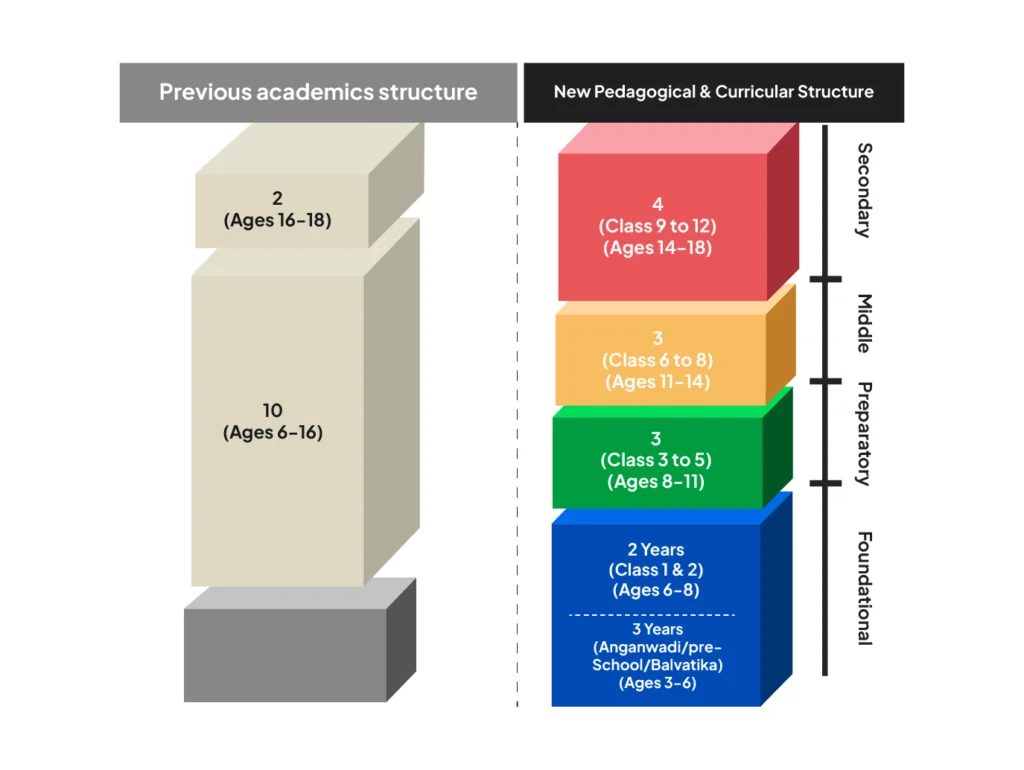
Foundational Stage (Ages 3–8)
At the foundational stage, learning is play-based and experiential. Reporting focuses on:
foundational literacy and numeracy readiness
language development and expression
physical and motor skills
curiosity, engagement, and participation
emotional security and social interaction
Formal marks are de-emphasised in favour of descriptive indicators and teacher observations.
Preparatory Stage (Grades 3–5)
As learning becomes more structured, reports integrate:
conceptual understanding in core subjects
early problem-solving ability
communication and collaboration
learning habits such as effort and persistence
Progress is communicated through trends and descriptors rather than high-stakes grades.
Middle Stage (Grades 6–8)
At this stage, holistic reports emphasise:
subject-specific competencies
critical thinking and application of knowledge
project-based learning outcomes
teamwork, leadership, and emotional regulation
Rubric-based assessment becomes particularly effective here.
Secondary Stage (Grades 9–12)
While examinations remain important, holistic reporting continues to provide depth by documenting:
academic progress with trend analysis
research and inquiry skills
self-management and time planning
student interests, electives, and career readiness
reflective goal-setting
This ensures holistic development even in exam-oriented years.
Core Dimensions of a Holistic Progress Report
A robust Holistic Progress Report typically integrates the following dimensions:
Academic Progress
Learning outcomes achieved, improvement trajectories, strengths, and areas requiring support.
Skills and Competencies
Communication, critical thinking, collaboration, creativity, and problem-solving aligned with NEP 2020.
Learning Habits and Behaviour
Effort, persistence, responsibility, organisation, and independence.
Attendance and Engagement
Patterns of participation, consistency, and involvement in learning activities.
Socio-Emotional Development
Confidence, self-awareness, emotional regulation, and peer relationships.
Student Voice
Student reflections, learning insights, challenges, and personal goals.
Co-Curricular and Life Skills
Participation in sports, arts, clubs, leadership, and community activities.
Together, these dimensions provide a 360° view of student growth.
Roles in Holistic Progress Reporting
Teachers
Provide professional observation, formative assessment, and instructional insight grounded in evidence.
Students
Actively reflect on learning, set goals, and develop ownership of growth.
Parents
Gain clarity on development beyond marks and receive actionable guidance for support at home.
This shared model strengthens transparency, trust, and alignment.
Implementing Holistic Progress Reports Without Teacher Burnout
Holistic reporting does not increase workload when assessment is embedded into daily teaching.
Effective implementation rests on four principles:
Clear, Shared Rubrics
A limited set of well-defined competencies and habits reduces subjectivity and repetitive writing.
Continuous Micro-Evidence
Brief, regular observations—checklists, tagged notes, indicators—captured during learning.
System-Supported Synthesis
Digital platforms compile evidence across time, generating structured summaries for teacher review.
Action-Oriented Communication
Reports focus on insights and next steps rather than lengthy narratives.
When supported by the right systems, holistic reporting becomes more efficient over time This approach effectively functions as a student progress tracking system, enabling schools to monitor growth continuously across academic, skill, and wellbeing domains.
Why Holistic Progress Reports Matter for Indian Schools
Holistic Progress Reports:
align schools with NEP 2020 mandates
support competency-based education
improve parent-school communication
empower students as reflective learners
protect teacher wellbeing
create meaningful, longitudinal learning records
They shift assessment from judgment to development and from comparison to growth.
Conclusion: Reporting That Reflects Real Learning
Education in India is undergoing a profound transformation. As learning evolves, assessment and reporting must evolve with it.
Holistic Progress Reports capture learning in its full richness—academic, social, emotional, and behavioural. They translate NEP 2020 from vision into practice and ensure that schools nurture the whole child, not just exam performance.
When schools report on the whole child, they build learners prepared not just for exams, but for life.
Modernise Holistic Reporting with EDU
Edu enables NEP 2020–aligned Holistic Progress Reports through:
rubric-based assessment
continuous evidence capture
automated report synthesis
teacher-controlled approvals
All without increasing teacher workload.
Book a personalised demo today to see how Edu simplifies NEP 2020–aligned holistic progress reporting.
Frequently Asked Questions
What is a Holistic Progress Card (HPC) as per NEP 2020?
A Holistic Progress Card (HPC) is a comprehensive student report introduced under NEP 2020 that captures a child’s academic progress along with skills, competencies, behaviour, engagement, and socio-emotional development. Unlike traditional report cards, it focuses on continuous growth over time rather than only marks or exam results.
How is a Holistic Progress Card different from a traditional report card?
Traditional report cards primarily report marks or grades for subjects.
Holistic Progress Cards, on the other hand:
track learning across multiple domains
include skills, habits, and socio-emotional growth
show progress trends over time
incorporate student reflection and teacher observation
This makes HPCs more descriptive, developmental, and learner-centric.
What areas are covered in a Holistic Progress Report?
A Holistic Progress Report typically covers:
academic learning and outcomes
skills and competencies (communication, critical thinking, collaboration, etc.)
learning habits and behaviour
attendance and engagement patterns
socio-emotional development
co-curricular participation
student self-reflection and goals
Together, these provide a 360° view of student development.
How can schools implement the Holistic Progress Card (HPC)?
Schools can implement the Holistic Progress Card through a structured, phased approach aligned with NEP 2020. The process typically includes:
Define competencies and outcomes
Create clear rubrics and descriptors
Adopt continuous and formative assessment
Include student reflection and self-assessment
Train teachers and align workflows
Use digital systems for consolidation and reporting
By embedding assessment into everyday learning and using clear frameworks, schools can implement Holistic Progress Cards effectively without increasing teacher workload.
Can Holistic Progress Cards (HPCs) be customised for different schools?
Yes. Holistic Progress Cards are designed to be flexible and adaptable to the context of each school. While NEP 2020 and PARAKH provide a national framework and guiding principles, schools can customise HPCs based on their curriculum, pedagogy, student needs, and institutional values.
Schools may customise:
learning outcomes and competencies aligned with their board or curriculum
skill and behaviour rubrics suited to their teaching approach
co-curricular and enrichment components
reporting formats and communication styles for parents
What remains consistent is the holistic, competency-based approach to assessment. Customisation allows schools to maintain their unique identity while staying aligned with national policy expectations.
EDU supports full customisation of Holistic Progress Reports, enabling schools to design HPC frameworks that match their academic philosophy while remaining aligned with NEP 2020 guidelines.
How are skills assessed in a Holistic Progress Card?
Skills are assessed using rubrics and observable indicators rather than marks. Teachers document evidence through classroom activities, projects, discussions, and real-life applications. This evidence is collected continuously to reflect authentic skill development.
How does the Holistic Progress Card benefit students?
Holistic Progress Cards help students:
understand their strengths and areas for improvement
develop self-awareness and reflection skills
set meaningful learning goals
view assessment as feedback rather than judgment
This supports confidence, motivation, and long-term learning.
How does the Holistic Progress Card support parents?
For parents, HPCs provide:
clear insights beyond marks
understanding of learning habits and wellbeing
guidance on how to support learning at home
This improves parent-school communication and reduces confusion around grades.
Are Holistic Progress Cards applicable to all classes?
Yes. Under NEP 2020’s 5+3+3+4 structure, Holistic Progress Cards are designed for:
Foundational Stage
Preparatory Stage
Middle Stage
Secondary Stage
The format evolves with age, but the holistic approach remains consistent.
Why are Holistic Progress Reports important for modern education?
Holistic Progress Reports align assessment with real learning, life skills, and wellbeing. They support competency-based education, strengthen communication among stakeholders, and ensure students are prepared not just for exams, but for lifelong learning.